Resource Library

At CCEC, we know communities are at different stages of working on various local climate and energy priorities. Whether you’re building EV charging infrastructure, helping property owners afford energy upgrades, or developing electrification plans and codes, you need a way to find all the best information when you’re ready to use it to inform your work. This resource library is designed to give you multiple ways to access the broad array of resources CCEC continuously compiles immediately. Here are a few examples of how you might use the filters to query our content:
  • You’ve been directed to initiate a new energy or climate project and hope to advance your knowledge and accelerate the process by accessing relevant best practices, case studies, technical assistance, guides, learning events, reports, and tools;
  • You want to get an idea of the kinds of initiatives other communities are doing, especially in your region or for a particular sector;
  • and many more!
Don’t see an important resource or have one to share? Let us know by contacting eecoordinator@civicwell.org.
Reports

2023 CCEC Annual Report

The purpose of the California Climate and Energy Collaborative (CCEC) is to support local governments to save energy, reduce greenhouse gas emissions, and accelerate climate action by building knowledge and networks amongst local government practitioners. This 2023 CCEC annual report summarizes and reviews the progress we’ve made in doing so over the last year.

Organization: CivicWell
Organization Type: Nonprofit Organization
Region: Statewide
Date: 2023
Published in 2024
Sectors Targeted: Local Governments, Nonprofit
Reports

2024 CCEC Annual Report

The purpose of the California Climate and Energy Collaborative (CCEC) is to support local governments to save energy, reduce greenhouse gas emissions, and accelerate climate action by building knowledge and networks amongst local government practitioners. Now that the 2024 has come to a close, the CCEC is pleased to announce the publication of its 2024 Annual Report! This annual report covers all the highlights from our various offerings throughout the year. This fact sheet includes a brief overview of our Annual forum held in Palm Springs this past June , coordination and informational meeting participation rates, resource and newsletter reach, and notes on our growing network. We are proud to share this annual report that recognizes and celebrates the strides that we have made together toward our collective climate and energy goals. This report highlights the importance of sharing knowledge, resources, ideas, and inspiration as we move into 2025.

Organization: CivicWell
Organization Type: Nonprofit Organization
Region: Statewide
Date: 2024
Published in 2025
Sectors Targeted: Local Governments, Nonprofit
Learning Event

A Call to Invest in Community Power: Lessons Learned From California Climate Investments and the Community Solar Pilot

Since 2013, California Climate Investments (CCI) have implemented over $11B for projects ranging from clean energy and electric vehicles, to affordable housing and alternative fuel production. What have been the outcomes of these investments and what lessons can be learned? We will share findings from equity analysis of CCI co-produced by the Greenlining Institute and the USC Equity Research Institute. The session will spotlight one case study in particular, on the Low-Income Weatherization Program (LIWP) Community Solar Pilot, which produced the first publicly-funded community solar project on Tribal lands in California. Through a partnership between the Santa Rosa Band of Cahuilla Indians, Anza Electric Cooperative, and GRID Alternatives, the project created a 994-kilowatt system that is providing energy and benefits to ~200 households. The session will share lessons learned on effective partnerships and centering community participation, particularly as funding for projects in low-income, rural, and tribal communities continue to be implemented.

  • Lisa Castilone | Director of Tribal Programs, Grid Alternatives, Inland Empire
  • Steven Estrada | Tribal Chairman, Santa Rosa Band of Cahuilla Indians
  • Austin Mendoza | Data Analyst, USC Equity Research Institute
  • Kevin Short | General Manager, Anza Electric Cooperative
  • Moderator: Lolly Lim | Program Manager of Climate Investments, Greenlining Institute
Region: Inland Empire
Date: June 25, 2024
Published in 2024
Topic Areas: Financing/Funding, Renewable Energy & Storage
Additional notes of interest: 2024 CCEC Forum Resources, 2024 Forum Breakout
Case Study

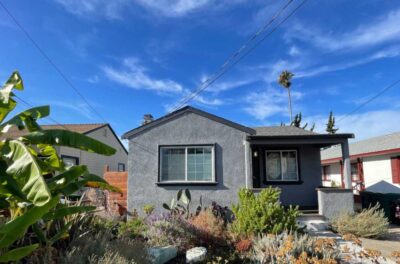
A Labor of Love: An Energy Efficient Upgrade of a 1940s Home

As realtors often say, every house has a story to tell. In a quiet community-driven neighborhood in Oakland, there’s a 1940s home that has been given a new lease on life. When Emily Alvarez, BayREN’s Green Labeling Program Lead, and her husband chose to buy their fixer upper in 2016, they knew that it would be an opportunity to create a home that is comfortable and cozy. Seven years later, Emily is now showcasing it as a green home to a group of realtors as part of their training.  

Evaluating the Home’s Energy Efficiency 

Before embarking on any upgrades, Emily sought to understand the energy efficiency landscape of her home. She obtained a BayREN Home Energy Score (and an associated rebate), which rates a home’s energy efficiency on a scale of 1 to 10. In 2019, their home scored a five. Acting on the recommendations, Emily and her husband made a series of changes that ultimately boosted the score to a perfect ten in 2023. This is how they did it:  

Enhancing the Building Envelope and Improving Energy Efficiency

In the realm of energy efficiency, it’s often advised to begin the home upgrade journey with building envelope enhancements. These upgrades focus on improving the components that impact a building’s thermal performance and energy consumption. For Emily, the process began with air sealing. By closing up any openings and preventing leaks that allow indoor air to escape and outside air to infiltrate. This not only helps maintain a consistent indoor air temperature but also keeps unwanted outdoor air pollutants and acts as pest control.

Air sealing goes hand in hand with insulation. Insulation traps heat inside during the winter and keeps heat out during the summer. Emily considered using blow-in insulation for the walls, but due to concerns on piercing plaster, she decided to focus on floor and attic insulation. Floor insulation was complemented with a Vapor Barrier, a thin material that prevents moisture from penetrating the insulation, keeping it dry and mold-free. Although the walls weren’t insulated, the combination of attic and floor insulation significantly improved indoor comfort and reduced energy bills. 

After enhancing the building envelope, Emily replaced the inefficient gas furnace with a heat pump for year-round heating and cooling. This appliance offers year-round comfort in a highly efficient manner, as it transfers heat from one place to another instead of generating it. The air sealing, insulation, and heat pump upgrades qualified Emily for BayREN and TECH Clean California (TECH) rebates. 

The crawl space of Emily’s home showing the Vapor Barrier (right) and the heat pump condenser unit (left).

A Safer, Faster Kitchen 

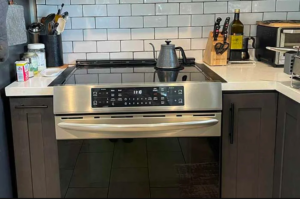
While not a necessity in Emily’s home journey, upgrading to an induction range was an important personal choice. DIY air quality testing in her kitchen revealed high formaldehyde levels and other pollutants when cooking on a gas range, even with the kitchen exhaust fan and an air purifier running. Emily found that transitioning to an induction range not only improved indoor air quality but also improved her cooking experience through precise heat control. “It is especially fun to cook on an induction stovetop when making a slow cooked meal as I am not constantly turning the heat up and down to retain a consistent temperature.” To install this all-electric appliance, it was necessary for Emily to upgrade to a 240-volt outlet. BayREN provided a rebate to support the shift to an electric induction stove.  

Emily’s induction kitchen upgrade. 

“It doesn’t matter how your water is heated!” 

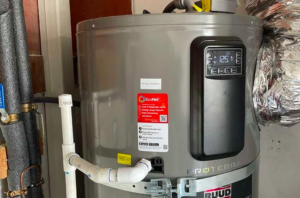
With an average useful life of 7-10 years, it is often recommended to replace a gas water heater before it breaks down in an emergency. Anticipating this needed upgrade and to further reduce her reliance on gas, Emily installed a heat pump water heater. She programmed it to heat water during off-peak energy demand hours and vented the cool air it exhausts into the attic to keep the space dry. Like the induction cooktop, it requires some fine-tuning to master the settings, which your contractor can assist you with. Emily shared, “it doesn’t matter how you heat your water, as long as it is hot!” BayREN offers rebates for this upgrade as well as TECH. 

The heat pump water heater ventilating to the attic. 

Electrical Panel Upgrade 

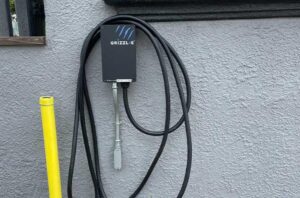
An upgrade of the electrical panel was necessary to safely operate all-electric appliances, including the heat pump water heater, induction range, and electric car charging station. “Upgrading my panel was unexpectedly the hardest part of my journey. It can take a while and phasing it with the rest of the electrification installation was challenging.” Emily also had to rewire her home to remove knob and tube and support the panel upgrade and electric appliances. Be sure to start this process early and really consider whether panel upsizing is necessary to save time and money.  Emily obtained a TECH rebate to offset part of the upgrade costs.

The at-home electric vehicle charger installed in the driveway. 

Drought-Tolerant Native Garden 

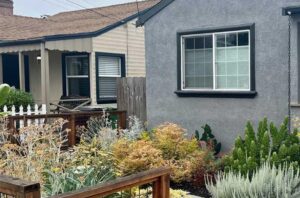
The home’s exterior also received a makeover with a drought tolerant garden. Emily’s garden started with sheet mulching, an organic gardening technique that avoids plastic and chemicals to enhance the soil. Sheet mulching enabled them to create a garden that suppressed weed growth, conserved water, and minimized maintenance. Emily used education information from StopWaste to start the sheet mulching journey.  

Emily’s drought-tolerant garden. 

Future Solar Panels and Battery Storage 

Emily plans to install solar panels and battery storage in the future. This upgrade will allow her to produce her own energy, contribute excess energy to the grid, and have power during emergency outages. Due to a power outage during a transformer fire, Emily was unable to use the induction cooktop for an 8-hour timespan. This unforeseen situation forced them to use their outdoor grill for the day, however they still had access to hot water reserve. “While we don’t come across these situations often, we are hoping to be better prepared for future power outages while producing our own solar energy.”  

Associated Costs 

Over the course of a couple years, Emily and her husband meticulously transformed their home. The total cost of their energy upgrades – including electrical upgrades, building shell measures, appliances and equipment, and an EV charger – amounted to $46,000 for improved comfort and sustainability, with $13,000 covered through rebates from BayREN, TECH, and Chevy (for their electric vehicle charger). Their journey began in 2019 when they first acquired a Home Energy Score (HES) to assess their options. They carefully planned their energy-efficient upgrades, aligning them with rebate programs like TECH, which are only accessible periodically, ensuring they maximized their financial benefits.  Subsequently, they strategically timed their renovations when they had the necessary financing in place, leveraging available rebates to make their project more cost-effective.  

As a result of their home upgrade project, Emily and her husband not only improved their home’s comfort but also set themselves up for significant savings on their monthly utility payments. When investing in a house, you are not just committing to a mortgage payment, you are also investing in your monthly utility payment. When gas prices increased in the winter of 2023, Emily was comfortable in her home and paid much less in her all-electric home compared to heating with an inefficient gas furnace. Their bills were lower than many of their friends, even accounting for charging an electric vehicle. Emily expects their bills to reduce further when they install solar panels.  

Key Takeaways 

Emily and her husband’s journey to enhance their home was a labor of love. Emily aptly says, “It’s hard to put a price on comfort and health,” but she hopes that any future realtor and buyers will appreciate the upgrades they’ve made. From insulation to induction cooktops, Emily’s home is a glimpse into the future opportunities for many homes in the Bay Area.  

To embark on your own home upgrade journey, consider consulting with BayREN’s no-cost Home Energy Advisors: https://www.bayren.org/energy-advisor

Are you a realtor looking to learn about green homes? Check out our events calendar for our next NAR’s GREEN Designation Class to learn about the issues and opportunities of energy efficiency in the real estate market: https://www.bayren.org/events-training

Name: Yeymi Reyes
Title: Communications Coordinator
Organization: BayREN
Organization Type: Other Local Government
Region: San Francisco Bay Area
Published in 2023
Topic Areas: Energy Efficiency
Additional notes of interest: CURRENTS
Learning Event

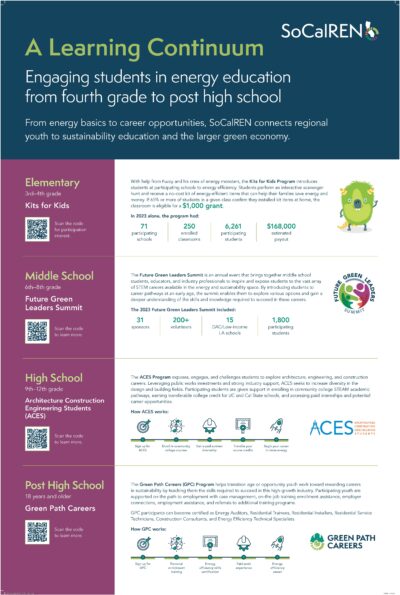
A Learning Continuum – Engaging students in energy education from fourth grade to post high school

Name: Savi Bassa
Title: Program Manager
Organization: ICF
Organization Type: Other Private Sector Business
Date: June 25, 2024
Published in 2024
Topic Areas: Workforce Development
Additional notes of interest: 2024 CCEC Forum Resources, 2024 Forum Poster
Learning Event

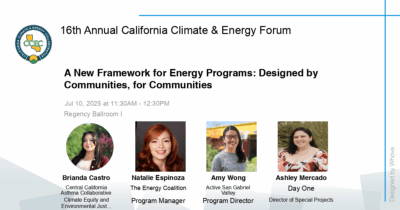
A New Framework for Energy Programs: Designed by Communities, for Communities

This session spotlights the Community-Based Design Collaborative (CBDC), a pioneering initiative launched by SoCalREN and funded by the CPUC, that reimagines how energy programs are designed by centering the voices of communities they aim to serve. Panelists representing community-based organizations across Kern, Los Angeles, San Bernardino, and Ventura Counties will share lessons from the Collaborative’s first year, including co-creating a scalable framework for equitable, locally tailored energy solutions. With members specializing in public health, transportation, environmental justice, and more, the CBDC reflects vulnerable communities’ rich diversity and expertise. The panel will explore how deep engagement, shared decision-making, and equity-centered design can yield replicable, community-powered programs aligned with state equity goals. Attendees will be invited to participate in interactive discussions that mirror the Collaborative’s design process, offering a dynamic space to share insights, spark innovation, and shape actionable strategies for local climate resilience.

Speakers
  • Brianda Castro, Central California Asthma Collaborative, Climate Equity and Environmental Justice Associate
  • Natalie Espinoza, The Energy Coalition, Program Manager
  • Amy Wong, Active San Gabriel Valley, Program Director
  • Ashley Mercado, Day One, Director of Special Projects
Moderator
Organization Type: City or County, Other Local Government, Nonprofit Organization
Region: Statewide
Date: July 10, 2025
Published in 2025
Topic Areas: Partnerships
Additional notes of interest: 2025 CCEC Forum Resources, 2025 Forum Breakout
Learning Event

Accelerating Clean Energy in Rural and Disadvantaged Communities

Energy efficiency works the same in rural and disadvantaged communities as it does anywhere else, right? The short answer is, not exactly.

Implementing clean energy projects in these communities comes with its own unique set of challenges, some of which include fiscal, geographical, and political. During this breakout session, we will take a closer look at how people in these communities are able to achieve success in implementing clean energy projects despite their many obstacles.

To illustrate these challenges and successes, this panel will explore energy efficiency from each perspective including small cities with a population of less than 20,000, a larger city with a population of more than 500,000 as well as the energy efficiency program implementer in their service territory. All of the cities represented are classified as disadvantaged and 2 of the 3 are classified as rural as per the CalEnviroScreen 4.0 tool.

Speakers

  • Ann Kloose, City Of Fresno Sustainably Division
  • Mark Staples, City of Taft, Director of Planning and Development Services
  • Christine Viterelli, City of Arvin, Grants Manager
  • Rochelle Butler (Moderator), SJVCEO, Energy Manager
  • Michelle Villa (She,Her), Willdan Energy Solutions, Account Manager
Name: Rochelle Butler
Title: Energy Manager
Organization: San Joaquin Valley Clean Energy Organization
Organization Type: City or County
Region: Statewide
Date: September 22, 2022
Published in 2022
Topic Areas: Energy Efficiency, Renewable Energy & Storage
Sectors Targeted: Disadvantaged Communities, Local Governments
Additional notes of interest: 2022 CCEC Forum Session
Learning Event

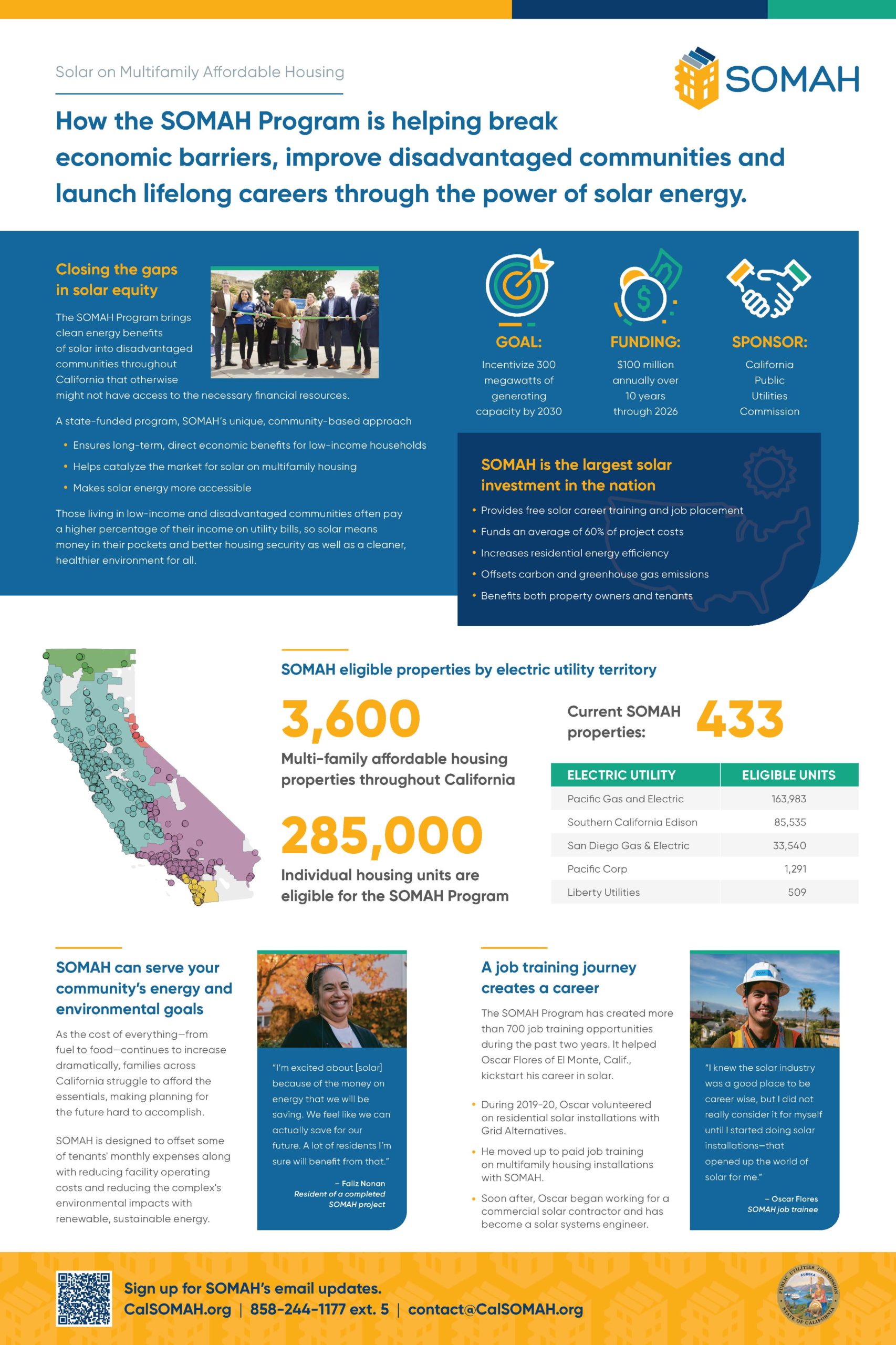
Access to Solar Brings Power: Centering Community in the Solar on Multifamily Affordable Housing (SOMAH) Program

Name: Marisa Villarreal
Title: Senior Program Manager
Organization: SOMAH
Organization Type: Nonprofit Organization
Region: Statewide
Date: September 22, 2022
Published in 2022
Topic Areas: Renewable Energy & Storage
Sectors Targeted: Residential
Additional notes of interest: 2022 CCEC Forum Poster
Learning Event

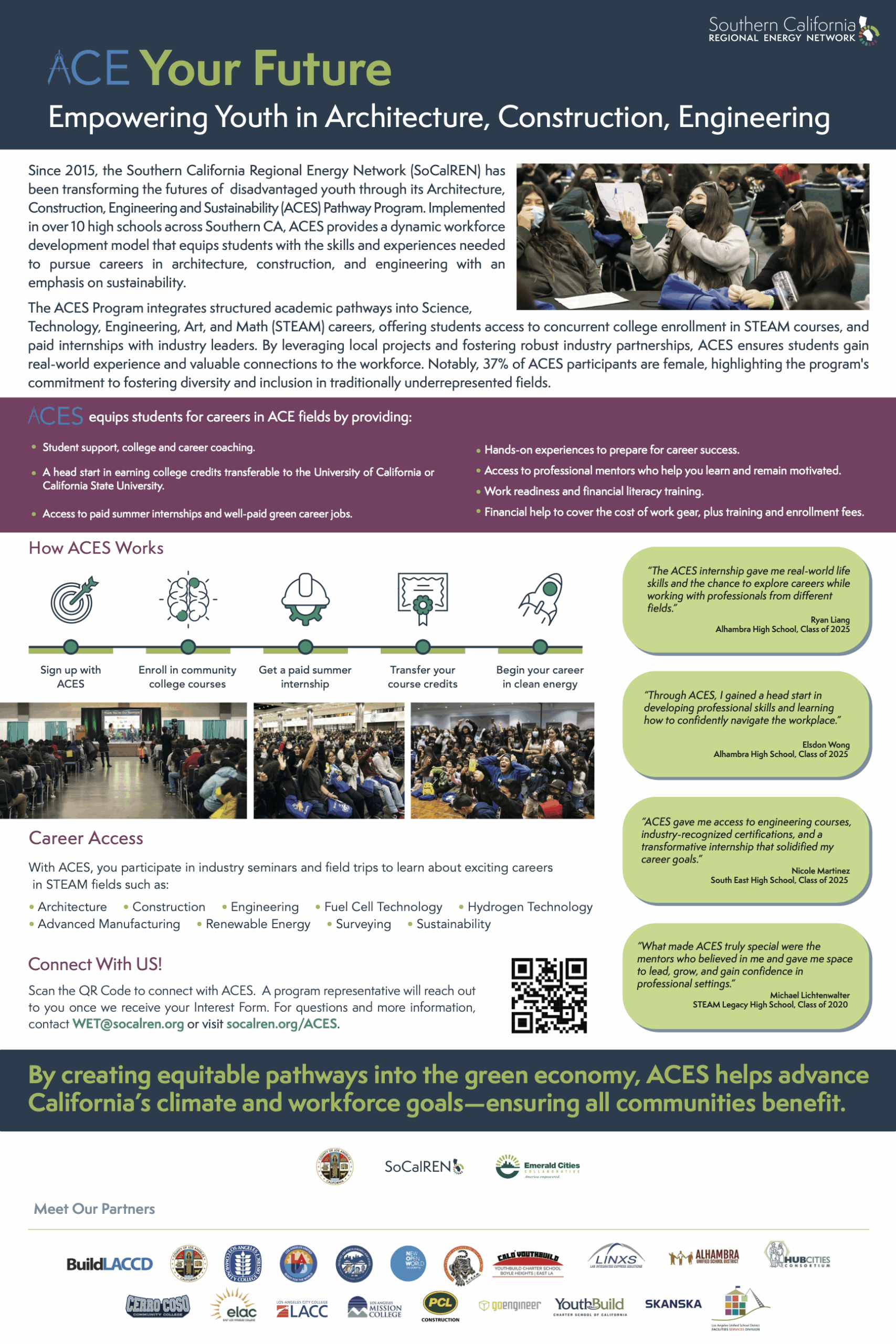
ACE Your Future: Empowering Youth in Architecture, Construction, and Engineering

Organization: SoCalREN
Organization Type: Other Local Government
Region: Greater Los Angeles
Date: July 9, 2025
Published in 2025
Topic Areas: Outreach and Engagement, Workforce Development
Sectors Targeted: Disadvantaged Communities, Residential
Additional notes of interest: 2025 CCEC Forum Poster, 2025 CCEC Forum Resources
Learning Event

Achieving Equitable Decarbonization: Lessons from International Local Government Perspective

With state and federal imperatives to decarbonize through electrification in the midst of steadily rising electricity rates, local governments are being looked to as critical change agents. The panel will discuss how California is not alone in struggling to address climate change, outline a series of roles local governments could take to help lead the way, and discuss a possible high distributed energy resources future. The session will culminate with a discussion on the best role for local governments, and how the Local Government Sustainable Energy Coalition is supporting equal decarbonization. Topics include European Union directives for smart local energy markets, California regulatory opportunities, local resilience and decentralized energy, and perspectives from a local elected official on the path forward. 

Speakers

  • Marc Costa, The Energy Coalition, Director of Policy and Planning
  • Steven Moss, M. Cubed, Partner
  • Arlis Reynolds, City of Costa Mesa, Councilmember
  • Lorenzo Kristov, PhD, Independent Consultant
Name: Marc Costa
Title: Director of Policy and Planning
Organization: The Energy Coalition
Organization Type: Nonprofit Organization
Region: Statewide
Date: 06/14/2023
Published in 2023
Topic Areas: Building Decarbonization, Distributed Energy Resources, Partnerships
Sectors Targeted: Local Governments
Additional notes of interest: 2023 CCEC Forum Resources
Learning Event

Addressing Barriers to EVI Deployment in Disadvantaged Communities

While some of the approaches to deploying EVI in rural and DAC communities compare to other regions (e.g., increase awareness, increase affordability, reduce range anxiety, provide funding opportunities, streamline permitting), there are also unique approaches that are beneficial to communities where: air quality improvement is a priority; Residents are multi-cultural and speak numerous languages; Significant residents do not have access to home charging (e.g., MUDs); Daily commutes to work are above average; Corridor travel is significant; and existing rebate programs have not been fully utilized.

In this session, we will explore the barriers that are common to all and unique to these communities. We will ask for audience participation to prioritize deployment strategies, share results of work conducted, and provide toolkits for decision-makers to utilize in their own community.

Speakers:

  • Kevin Wood, Center for Sustainable Energy
  • Linda Urata, County of Kern
  • Christine Viterelli, City of Arvin
  • Jack Axelrod, Envoy
Name: Kevin Wood
Organization: Center for Sustainable Energy
Organization Type: City or County, Governmental Association, Other Private Sector Business, Nonprofit Organization
Region: Inland Empire, San Joaquin Valley, Statewide
Date: 06/26/2019
Published in 2019
Topic Areas: Electric Vehicles and Clean Mobility, Environmental Justice
Sectors Targeted: Disadvantaged Communities
Additional notes of interest: 2019 SEEC Forum Resources
Learning Event

Advanced Community Energy

UC Irvine’s Advanced Power and Energy Program partnered with the City of Huntington Beach, Altura Associates, Southern California Edison, and Southern California Gas, and the National Renewable Energy Laboratory to develop tools to optimally design and operate an Advanced Energy Community in Oak View community.

Organization: UC Irvine's Advanced Power and Energy Program
Region: Greater Los Angeles
Date: April 2018
Published in 2018
Topic Areas: Distributed Energy Resources
Case Study

Advanced Energy Rebuild Napa Program

MCE, The Bay Area Air Quality Management District (BAAQMD), BayREN, Napa County, and PG&E have joined efforts to help property owners in Napa County who lost homes in the October 2017 and 2018 wildfires. Advanced Energy Rebuild Napa will provide incentive to support homeowners in rebuilding energy efficient, sustainable homes to 2016 code.

Organization: Marin County Energy
Organization Type: Other Local Government
Region: San Francisco Bay Area
Published in 2021
Topic Areas: Energy Efficiency
Learning Event

Advancing Resource Accessibility & Energy Resilience: The Energy Education & Resource Hub

Organization: SDRCC
Organization Type: Nonprofit Organization
Region: San Diego
Date: September 22, 2022
Published in 2022
Topic Areas: Energy Efficiency
Sectors Targeted: Local Governments
Additional notes of interest: 2022 CCEC Forum Poster
Case Study

Agency Buys PPA with help from TerraVerde

TerraVerde recently supported one of their clients in buying out their solar PPA. This client, a Water Agency served by Southern California Edison (SCE) negotiated a buyout by leveraging available capital, monetizing renewable energy certificates and increasing energy production by re-powering the system. The agency Increased their utility bill savings, made revenue from energy certificates and will have a net financial outcome of 7.9% IRR.

Name: CEO
Title: TerraVerde Energy
Organization: TerraVerde Energy
Organization Type: Other Private Sector Business
Region: Statewide
Published in 2021
Topic Areas: Financing/Funding, Renewable Energy & Storage
Sectors Targeted: Local Governments
Learning Event

Aligning State & Regional Goals at the Nexus of Housing & Climate

On July 31, 2024, Governor Newsom issued a new executive order (N-2-24) to accelerate and streamline infill development projects to transform undeveloped and underutilized properties statewide into livable and affordable housing for Californians. This session seeks to gather input from Tribes, local and regional governments, and advocacy organizations on processes, permits, and other administrative actions that can be adjusted to create flexibility and lower the per-unit cost of infill housing.

  • Sean Kennedy, Deputy Director of Energy Investments, CA Strategic Growth Council
  • Clay Kerchof, Climate & Transportation Section Chief, CA Department of Housing & Community Development
  • Tawny Macedo, Housing Policy Manager, CA Business, Consumer Services and Housing Agency
  • Aaron Savage, Associate Planner, Governor’s Office of Land Use and Climate Innovation
Region: Inland Empire
Date: 12/5/2024
Published in 2024
Topic Areas: Land Use
Additional notes of interest: REACH IE
Case Study

Architecture Construction Engineering Students (ACES) Pathway Program

SoCalREN’s Architecture, Construction, Engineering Students (ACES) Pathway Program encourages middle school and high school students to explore careers in science, technology, engineering, arts, and mathematics (STEAM). Currently, six high schools participate in ACES, with nearly 400 students enrolled in the program. Students have access to earning transferable college credits through their local community college and paid summer internships. The goal of this program is to provide students hands-on experience to enter the architecture, engineering, sustainability, fuel cell technologies, advanced manufacturing, construction, renewable energy, hydrogen technology, and surveying industries. This program addresses the gaps seen in these industries of people of color and community members.

Name: Wendy Angel
Title: Program Director
Organization: SoCalREN
Organization Type: Other Local Government
Region: Greater Los Angeles
Published in 2021
Topic Areas: Workforce Development
Sectors Targeted: Disadvantaged Communities
Technical Assistance Provider

Association of Bay Area Governments – BayREN

An Individual local government professional offering peer knowledge to other local government professionals, who has the willingness, capacity, and expertise to be contacted by local government energy and climate peers/professionals to share knowledge in the following types of programs, projects, or policies: Energy efficiency program design and implementation; information about creation of a Regional Energy Network (REN); successful models of local government collaboration. The elegibility restrictions are the following: None.

Name: Jennifer Berg
Title: Energy Programs Manager
Organization: Association of Bay Area Governments - BayREN
Organization Type: Other Local Government
Region: San Francisco Bay Area
Published in 2021
Topic Areas: Energy Efficiency, Partnerships
Technical Assistance Provider

Association of Monterey Bay Area Government

An Organization offering free technical assistance to local government professionals, who has the willingness, capacity, and expertise to be contacted by local government energy and climate peers/professionals to share knowledge in the following types of programs, projects, or policies: . The elegibility restrictions are the following: None.

Name: Amaury Bertead
Organization: Association of Monterey Bay Area Government
Organization Type: Other Local Government
Region: Central Coast
Published in 2022
Topic Areas: Climate Planning, Electric Vehicles and Clean Mobility, Energy Efficiency
Case Study

Association of Monterey Bay Area Governments’ Regional Greenhouse Gas Inventory Collaborative

While large metropolitan cities have been working on climate change mitigation projects for years, many of California’s smaller jurisdictions are in much earlier stages of grappling with greenhouse gas emissions. Many of these cities and counties lack the necessary staff and funds to devote to greenhouse gas reduction projects, and as a
result, the vast majority of AMBAG’s 21 jurisdictions had not quantified their baseline GHG emissions as of 2009. Recognizing the need for more support with local climate change efforts, AMBAG designed a program that would yield the following results:
• completion of local government operations inventories in 100% of AMBAG jurisdictions at NO COST to the municipal governments;
• capacity-building for jurisdictional staff;
• community capacity-building in the field of climate change mitigation; and
• standardized greenhouse gas inventories for regional comparability.

Organization: AMBAG
Organization Type: Other Local Government
Region: Central Coast
Published in 2011
Topic Areas: Climate Planning, Partnerships
Sectors Targeted: Local Governments
Filters
Resource Type
Reset
Topic Area
Reset
Regions Served
Reset
Organization Type
Reset
Sectors Targeted
Reset
Additional Notes of Interest
Reset
Only the first 250 values are displayed.