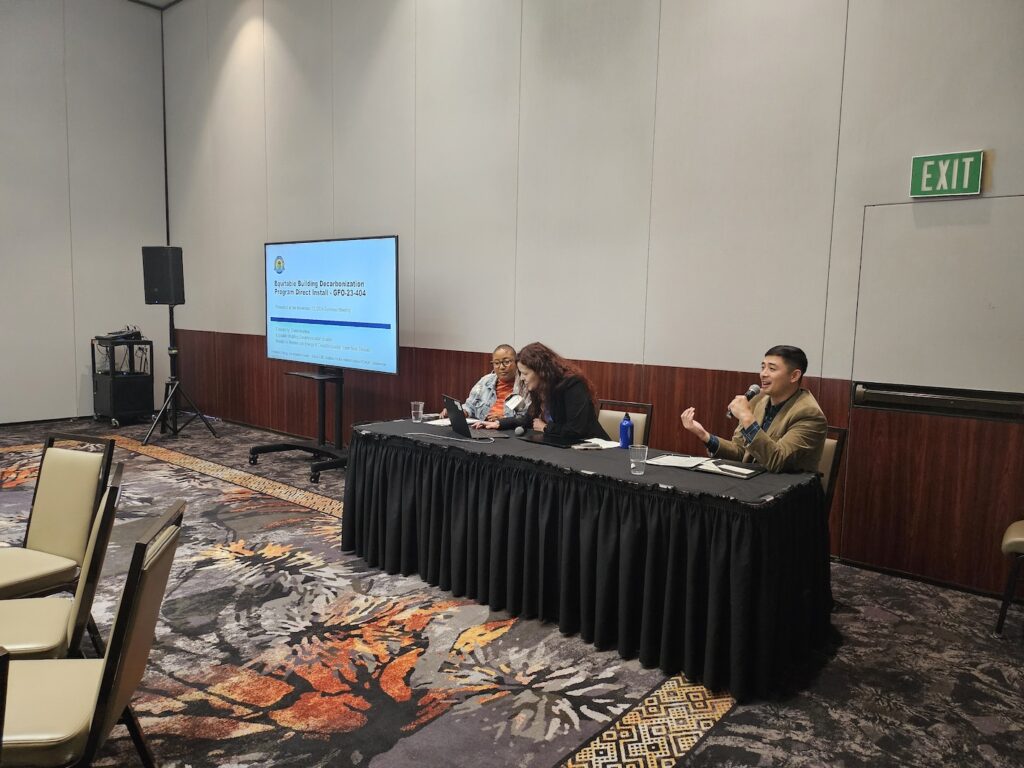
State & Local Energy & Climate Coordination (SLECC) Presents
REACH Inland Empire
REACH’s long term mission is to leverage the collective power of state, federal and regional capacity and resources to advance place-based energy, climate, and land use priorities through lasting regional hubs. It is community-driven (local gov, tribal gov, academic institutions, philanthropy, CBO/NGOs) and partners and engages with State and federal agencies.
In the effort to continue engagement in the Inland Empire (San Bernardino, Riverside and Imperial Counties) REACH is intended as an ongoing series. To that end we have created the opportunities below to stay engage and begin to plan future events.
CCEC will continuously work to build on what we are learning from the inland empire to build a landscape analysis and assistance guide for the region. These materials are intended to support community and state leaders as they seek to understand and serve the region and will evolve over time as we continue to engage. Like we said, Regional Energy and Climate Hubs (REACH) are intended to be more than just a convening!
Assistance Marketplace
The Assistance Marketplace is a constantly updated guide showcasing organizations in the inland empire that provide FREE funding, incentives, or technical assistance to local, tribal, CBOs, NGOs, or schools in the Inland Empire. Add your organization to the marketplace by filling out this form!
To increase visibility of the organizations in the Inland Empire which are already participating in REACH IE or who have been suggested by others to participate are shared in this filterable spreadsheet. Also available is information on the topic areas that the organizations need assistance with as well what topic areas they provide assistance. Feel free to add additional suggestions here on organizations that should be included on future REACH events.
CCEC has been compiling a dynamic report will continuously compile and refine a cumulative understanding of the key climate, energy, and land use priorities, players, and practices in the region known as the Inland Empire or Inland Deserts. This information is intended to help regional and state leaders better serve the region through improved access to funding, technical assistance, and helpful policies while reducing the need for duplicative, siloed, shallow, and time-consuming engagement from agencies and other service providers.
Key Priority Areas for the Inland Deserts Region – Defining Challenges and Identifying Solutions
The priorities, barriers, challenges, and potential solutions brought up in the Inland Deserts Region during the 2024 REACH IE event can be found below. CCEC is working to continuously update this information based on what we learn from the region. If you live or work in the greater Inland Deserts region please let us know how we can expand and refine our information. Either share new ideas, best practices or general feedback via this form, or click on a particular item to share additional feedback, information, examples of progress on that particular item.
Many small and rural jurisdictions lack staff and technical capacity—often relying on a single planner to manage CEQA reviews, general plan updates, and grant applications—making it difficult to maintain Climate Action Plans (CAPs).
Local leaders called for regional collaboration and alignment, leveraging COGs, RENs, and county planning hubs to share expertise, synchronize CAP and General Plan updates, and use integrated modeling tools like Cal-Adapt and the Vulnerable Communities Platform.
State solutions included modular, scalable guidance tailored to different community types and continued investment in regional technical assistance. Participants also highlighted the need for improved data access and stronger equity integration, citing progress through SGC’s TCC and CRC programs and UC Riverside’s Inland Deserts Regional Assessment as models for community-driven climate action.
Barrier 1: Planning Capacity
Too much local capacity (staff time/resources) and technical expertise is needed to develop/ track/ update greenhouse gas (GHG) inventories and climate action plans (CAPs), which takes away from implementation.
Key Challenges Identified
Key challenge discussed in - San Francisco Bay Area, Central Coast, San Joaquin Valley, Los Angeles, Inland Deserts, San Diego, Statewide
Chronic Staff Capacity Constraints. Small, rural, and under-resourced jurisdictions often rely on one planner to manage CEQA, General Plan updates, grant applications, and GHG inventories and CAPs, leaving little capacity for sustained climate planning or implementation. Climate work is added onto existing roles, and complex, non-user-friendly state guidance further exacerbates inequities with better-resourced jurisdictions that have dedicated climate staff.
Key challenge discussed in - Inland Deserts
Separate climate and general plans create fragmented, inefficient local government action. Most local jurisdictions develop Climate Action Plans separately from their General Plans, leading to inconsistent implementation across areas like housing, circulation, and open space. This siloed approach makes it harder to translate climate targets into land-use decisions and forces jurisdictions to maintain overlapping documents without shared metrics.
Local Solution Opportunities
Inland Desert stakeholders have brainstormed the following solution opportunities that can be taken by local leaders. Existing examples of progress or pathways to make further progress are highlighted if known.
Local or State
Solution
Existing Examples of Progress
Further Progress Pathways
Local Solution
(Type of Activity: Policy/Planning/Land Use )
Regional climate hubs, shared staffing models, and COG/REN-led technical assistance networks that pool expertise, standardize methods, align state–local requirements, and provide sustained planning and implementation support for under-resourced jurisdictions.
1. Past support from SANDAG in preparing GHG inventories was cited as reducing burdens on local staff. Loss of this support has worsened planning capacity issues. 2. AMBAG provided an example wherein regional staff can provide technical expertise to cities. 3. San Mateo County’s RICAPS (Regionally Integrated Climate Action Planning Support) is an effective example of regionalized CAP alignment and technical assistance. RICAPs provides regional CAP templates, standardized methodologies, shared communication materials and collaborative structures for cities. 4. Regional Climate Action Plan (funded by the EPA) in Santa Clara and San Benito Counties demonstrates an emerging model of cross-county CAP alignment that local governments can plug into. 5. Plan Bay Area 2050+ is an integrated regional plan under SB 375 that includes unified strategies for housing, transportation, the economy, and the environment. Aligning local CAPs with these cross-sector strategies can ensure consistency across local jurisdictions. 6. Regional collaborations: Some areas have created joint climate staff or shared services models so that small jurisdictions can pool resources to support CAP development and grant writing. 7. Regional technical assist model you can piggyback on: The REN-led “Energized Communities” program is built precisely because cities “don’t have staff bandwidth to do any of the work.” Use its scaffolding for CAP/inventory tasks (not just project delivery).
Local or State
Solution
Existing Examples of Progress
Further Progress Pathways
Local Solution
(Type of Activity: Policy/Planning/Land Use )
Standardized templates, shared data/modeling tools, streamlined CEQA/CAP requirements, and common dashboards and grant repositories to reduce duplication, shorten timelines, and lower staff burden.
ClimatePlans.org provides standardized GHG inventories, indicators, carbon calculators, policy tools and other resources for California local governments. https://climateplans.org/
Local or State
Solution
Existing Examples of Progress
Further Progress Pathways
Local Solution
(Type of Activity: Policy/Planning/Land Use )
Embedding Climate Work Across Departments. Jurisdictions can distribute climate planning and implementation responsibilities across departments by establishing cross-sector teams (e.g., planning, public works, transportation, housing), integrating CAP measures into routine operations and general plan elements rather than relying on a single sustainability role.
LCI's upcoming 2027 General Plan Guidelines Update: This update will embed climate mitigation, adaptation, and resilience across all elements, replacing standalone CAP sections. It includes new optional elements on urban design, water, and natural and working lands, each linked to climate policy outcomes.
Local or State
Solution
Existing Examples of Progress
Further Progress Pathways
Local Solution
(Type of Activity: Policy/Planning/Land Use )
Align local planning cycles: Cities and counties can plan concurrent updates of CAPs, General Plans, and zoning codes to ensure consistency and reduce duplicated effort—a concern noted by local planners who “don’t update zoning or CAPs that often” and need better cadence alignment with state data releases
LCI's upcoming 2027 General Plan Guidelines Update: This update will embed climate mitigation, adaptation, and resilience across all elements, replacing standalone CAP sections. It includes new optional elements on urban design, water, and natural and working lands, each linked to climate policy outcomes.
State Solution Opportunities
Inland Desert stakeholders have brainstormed the following solution opportunities that can be taken by state leaders. Existing examples of progress or pathways to make further progress are highlighted if known.
Local or State
Solution
Existing Examples of Progress
Further Progress Pathways
State Solution
(Type of Activity: Program Implementation and Outreach )
The state should fund trusted regional entities such as health departments, COGs, and RENs to provide sustained technical assistance and convening support to small CBOs and under-resourced jurisdictions, reducing the burden of climate planning through shared staffing, standardized tools, and training.
1. UC Berkeley's CoolClimate Network has developed a live GHG inventory and climate action data platform for California cities and counties, featuring inventories from 2010-2022 alongside actionable metrics like EV registrations and heat pumps installed that help local governments set concrete targets and communicate community benefits. 2. CARB has initiated research contracts, including one with Cal Poly, to identify challenges in GHG inventory development, evaluate existing tools, and develop best practices and capacity building resources for local jurisdictions. 3. In December 2025, CARB released new Planning and Capacity Building Grants for sustainable transportation designed to set the stage for future implementation grants. 4. The Grasslands Climate Stewards Program at UC Merced demonstrates a model for building locally rooted technical capacity through hands-on training, with goals to expand and offer continuing education credit by 2027.
1. CARB and LCI have formed a Climate Action Planning Technical Advisory Group to review CAP literature, inventory development, and integration with General Plans, with the goal of providing clearer state guidance on CAP creation and updates to help cities take more effective action. 2. CARB's Cap-and-Trade Investment Plan, which previously guided three-year allocation of auction proceeds, is not moving forward for 2025-2028 due to changes in the underlying statutory requirement, leaving stakeholders without a clear pathway to influence how Greenhouse Gas Reduction Fund proceeds will be allocated under the reauthorized Cap-and-Invest program.
Local or State
Solution
Existing Examples of Progress
Further Progress Pathways
State Solution
(Type of Activity: Program Implementation and Outreach )
Develop interactive, modular guidance as part of the General Plan Guidelines that scales by jurisdiction size and geography—e.g., allowing planners to input whether they are inland, coastal, or desert to receive customized climate strategies and sample policies
The proposed online GPG platform—with customizable recommendations by jurisdiction type—is cited as a major step forward in addressing the capacity gap for smaller and rural communities. LCI noted the next GPG update (2025–2027) aims to ensure that “wherever you’re from, whether a big city like Los Angeles or a part-time planner in Bishop, you can take these guidelines easily, see what you have to do, and integrate climate into your plan”
Barrier 2: Source Data
Problems accessing GHG source data (e.g., utility or vehicle miles traveled (VMT) data) cause long delays in developing, updating, and monitoring GHG inventories.
Key Challenges Identified
Key challenge discussed in - Inland Deserts
Local governments struggle to keep pace with evolving climate data and assessments when their planning documents—like general plans and zoning codes—are only updated once every few decades.
Local Solution Opportunities
Inland Desert stakeholders have brainstormed the following solution opportunities that can be taken by local leaders. Existing examples of progress or pathways to make further progress are highlighted if known.
Local or State
Solution
Existing Examples of Progress
Further Progress Pathways
State Solution
(Type of Activity: Policy/Regulation )
Enhance public access and coordination of climate data resources. Integrate and streamline climate data tools across universities and agencies, ensuring key datasets are updated frequently and made easily accessible to support local planning and decision-making.
Cal-Adapt follows the global climate data cycle—updated roughly every 5–6 years—and that the state is developing evolving tools like the Vulnerable Communities Platform to “add new information as it’s available” and help planners align to the latest assessment data
State Solution Opportunities
Inland Desert stakeholders have brainstormed the following solution opportunities that can be taken by state leaders. Existing examples of progress or pathways to make further progress are highlighted if known.
Local or State
Solution
Existing Examples of Progress
Further Progress Pathways
State Solution
(Type of Activity: Policy/Regulation )
Enhance public access and coordination of climate data resources. Integrate and streamline climate data tools across universities and agencies, ensuring key datasets are updated frequently and made easily accessible to support local planning and decision-making.
Cal-Adapt follows the global climate data cycle—updated roughly every 5–6 years—and that the state is developing evolving tools like the Vulnerable Communities Platform to “add new information as it’s available” and help planners align to the latest assessment data
Complex zoning, CEQA inconsistencies, and community resistance continue to limit infill and affordable housing development. Many cities struggle to balance growth with infrastructure and energy capacity, especially in the Inland Empire. Financing remains fragmented—requiring multiple grants and reviews that delay projects—while retrofits can unintentionally displace tenants. Growing heat, wildfire, and insurance risks further strain older housing stock and low-income renters. Jurisdictions are modernizing zoning to enable mixed-use and higher-density development, integrating infrastructure planning, and creating regional loan funds and project pipelines to reduce delays. Programs like Lift to Rise and Seaside’s infill model use storytelling and health framing to build public support. Local governments are also launching retrofit campaigns and local contractor pipelines while partnering with CBOs and health districts to protect residents from displacement, heat, and air quality risks.
The state can expand housing–climate incentives (Pro-Housing, AHSC, Infill Grants), align agency funding through SGC’s Housing, Climate, and Equity Resolution, and strengthen tenant protections tied to retrofit programs. Participants highlighted progress through California Jobs First, CARB’s heat and air-quality grants, and the Extreme Heat and Community Resilience Program, which integrate equity, housing, and climate resilience.
Barrier 1: Housing Regulation
Complex zoning laws, inconsistent CEQA requirements, lengthy permitting processes, and local opposition to new development have historically limited housing production and infill development.
Key Challenges Identified
Key challenge discussed in - San Francisco Bay Area, Central Coast, Los Angeles, Inland Deserts
Community resistance to housing development remains a major barrier (NIMBY Opposition). Local leaders noted that opposition—often framed as protecting neighborhood “green space” or preserving single-family character—can reflect deeper resistance to multifamily density and infill. Many residents still associate new housing with congestion or environmental harm rather than recognizing its potential to improve public health, cost efficiency, and climate outcomes.
Key challenge discussed in - Inland Deserts
Cities want to entice development but need to make sure its appropriate for different areas. Participants emphasized that existing zoning and building codes often make infill, mixed-use, or smaller-footprint housing difficult. Cities want flexibility to “allow more housing types and more places,” increase density near transit, and adopt more sustainable design requirements.
Local Solution Opportunities
Inland Desert stakeholders have brainstormed the following solution opportunities that can be taken by local leaders. Existing examples of progress or pathways to make further progress are highlighted if known.
Local or State
Solution
Existing Examples of Progress
Further Progress Pathways
Local Solution
(Type of Activity: Policy/Planning/Land Use )
Reform and modernize local zoning codes to replace exclusionary single-family and separated-use patterns with infill-oriented, mixed-use, and higher-density districts in walkable, transit-served areas. Updates should allow a wider range of housing types—including modular, mobile, small multifamily, and mixed-use buildings—while reducing unnecessary minimum home size requirements to expand affordability, flexibility, and climate-aligned community design.
1. City of Glendale – Since the 2000s, Glendale permitted 6–7-story mixed-use/apartment buildings in its commercial core. This long-term approach “flooded the market” with housing, keeping rents “pretty reasonable” compared to surrounding Los Angeles. Glendale is now layering parks, pedestrian, and bike plans after this growth, showing how infrastructure can catch up to zoning-enabled supply. Why it matters: Large-scale production moderated rents relative to surrounding LA markets; an example of land-use enablement delivering supply at scale. 2. City of Seaside’s planning approach prioritizes mixed-use infill development—combining housing, small businesses, and civic spaces within walkable districts. This structure reduces vehicle miles traveled (VMT), a major contributor to regional greenhouse gas (GHG) emissions, while encouraging economic vibrancy and livability. The city has repurposed underused parcels into compact, transit-oriented neighborhoods that integrate energy-efficient buildings, pedestrian pathways, and public gathering areas. 3. In San Francisco, participants described cities where upzoning from single-family to three-story buildings with no CEQA enabled more housing, and highlighted how split residential/commercial zoning and very little mixed zoning prevent “integrated neighborhood” development.
Local or State
Solution
Existing Examples of Progress
Further Progress Pathways
Local Solution
(Type of Activity: Community Program Implementation )
Launch coordinated, values-based pro-housing campaigns that engage trusted messengers and community partners to build support for infill and multifamily development. This includes organizing “say yes to housing” education efforts to counter NIMBY narratives; partnering with cultural, faith-based, and health organizations as trusted messengers; and framing well-planned housing as improving family stability, commute times, air quality, and community well-being.
1. The Inland Deserts Regional Assessment under the Fifth Climate Change Assessment is partnering with groups like Alianza Coachella to host art-based and health-focused engagement events, where storytelling and community art connect climate, housing, and social well-being. 2. Lift to Rise’s regional housing coalition in the Coachella Valley — cited as a model of collaborative storytelling and data-sharing that connects housing supply to health, cost, and climate benefits., resilient housing part of the region’s health and equity strategy
State Solution Opportunities
Inland Desert stakeholders have brainstormed the following solution opportunities that can be taken by state leaders. Existing examples of progress or pathways to make further progress are highlighted if known.
Local or State
Solution
Existing Examples of Progress
Further Progress Pathways
State Solution
(Type of Activity: Policy/Regulation )
Continue aligning housing and climate policy under cross-agency frameworks like the Strategic Growth Council’s (SGC) Housing, Climate, and Equity Resolution, which encourages joint planning among housing, transportation, and environmental agencies
Local or State
Solution
Existing Examples of Progress
Further Progress Pathways
State Solution
(Type of Activity: Program Implementation and Outreach )
Support community engagement funding around local housing growth.
Programs like the Transformative Climate Communities (TCC) and Community Resilience Centers (CRC) already require participatory governance and community representation, ensuring that outreach reflects local culture and priorities
Local or State
Solution
Existing Examples of Progress
Further Progress Pathways
State Solution
(Type of Activity: Policy/Regulation )
Provide technical assistance and incentives for local governments experimenting with flexible zoning and green building standards tailored to regional conditions (e.g., desert heat resilience in Coachella Valley versus infill cooling needs in San Bernardino).
Local or State
Solution
Existing Examples of Progress
Further Progress Pathways
State Solution
(Type of Activity: Program Implementation and Outreach )
Provide data-driven and culturally sensitive communication tools to support housing. State agencies such as LCI and SGC can help local governments by sharing accessible, multilingual data visualizations that show how housing supports reduced emissions, economic resilience, and child health outcomes.
Local or State
Solution
Existing Examples of Progress
Further Progress Pathways
State Solution
(Type of Activity: Program Implementation and Outreach )
Continue and expand state tools and incentives to entice local housing growth
HCD’s Pro-Housing incentives, the Affordable Housing and Sustainable Communities Program, and the Infill Infrastructure Grant, which connect new development to climate-friendly infrastructure and transit access
Barrier 2: Infrastructure for Housing Access
New developments must provide for access to schools, parks, utilities, and transportation infrastructure, which can exacerbate tensions between green space conservation and density and require lengthy approval processes creating costs and delays.
Key Challenges Identified
Key challenge discussed in - San Joaquin Valley, Inland Deserts
Aging and capacity-constrained utility infrastructure limits housing development across the region, with the burden falling disproportionately on disadvantaged communities already facing high energy costs and limited grid access.
Local Solution Opportunities
Inland Desert stakeholders have brainstormed the following solution opportunities that can be taken by local leaders. Existing examples of progress or pathways to make further progress are highlighted if known.
Local or State
Solution
Existing Examples of Progress
Further Progress Pathways
Local Solution
(Type of Activity: Policy/Planning/Land Use )
Integrate infrastructure planning into general plan and housing element updates, aligning growth areas with existing or planned energy and water capacity.
State Solution Opportunities
Inland Desert stakeholders have brainstormed the following solution opportunities that can be taken by state leaders. Existing examples of progress or pathways to make further progress are highlighted if known.
Local or State
Solution
Existing Examples of Progress
Further Progress Pathways
State Solution
(Type of Activity: Policy/Regulation )
The state should align housing, transportation, and infrastructure funding programs and streamline permitting and interconnection for energy and utility upgrades, enabling jurisdictions to pursue integrated development packages rather than navigating siloed programs with inconsistent timelines.
The Go-Biz TED Task Force (Tracking Energy Development) was cited as a state-level best practice for identifying infrastructure bottlenecks and coordinating permitting solutions for large-scale energy and housing-related projects
Local or State
Solution
Existing Examples of Progress
Further Progress Pathways
State Solution
(Type of Activity: Policy/Regulation )
Expand investment in transmission and distribution infrastructure to accommodate population and housing growth.
Local or State
Solution
Existing Examples of Progress
Further Progress Pathways
State Solution
(Type of Activity: Policy/Regulation )
The state should scale up energy infrastructure investment aligned with housing growth by ensuring CPUC, CEC, and LCI collaborate on regional energy forecasts and housing-ready infrastructure siting, reducing utility costs for residents and preventing grid capacity from becoming a barrier to housing development.
Barrier 3: Financing
Affordable housing developments require complex financing involving multiple funding sources, tax credits, and subsidies, creating lengthy development timelines. Limited federal and state affordable housing funds mean projects compete intensely for financing. Funding awards come with too many additional requirements.
Key Challenges Identified
Key challenge discussed in - San Francisco Bay Area, Central Coast, San Joaquin Valley, Los Angeles, Inland Deserts
Stacking multiple funding sources burdens affordable housing developers with complex compliance and delays. Affordable housing projects typically require stacking tax credits, subsidies, and grants — each with its own timelines and compliance requirements. This patchwork approach creates administrative burdens that slow project delivery and make funding difficult to access efficiently.
Key challenge discussed in - San Francisco Bay Area, Inland Deserts
Establish local and regional pooled housing trust funds and collaborative financing vehicles—leveraging public, private, and CDFI capital—to provide flexible, low-cost, patient loan products that allow affordable housing projects to move forward despite state and federal funding delays.
Local Solution Opportunities
Inland Desert stakeholders have brainstormed the following solution opportunities that can be taken by local leaders. Existing examples of progress or pathways to make further progress are highlighted if known.
Local or State
Solution
Existing Examples of Progress
Further Progress Pathways
Local Solution
(Type of Activity: Policy/Planning/Land Use )
Establish regional coordination mechanisms to collaboratively build pipelines of investable housing projects. By pre-identifying priority developments, pooling resources, and aligning multi-jurisdiction applications before approaching state and federal funders, regional entities can reduce duplicated effort, avoid competing against one another, and strengthen competitiveness for scarce dollars.
State Solution Opportunities
Inland Desert stakeholders have brainstormed the following solution opportunities that can be taken by state leaders. Existing examples of progress or pathways to make further progress are highlighted if known.
Local or State
Solution
Existing Examples of Progress
Further Progress Pathways
State Solution
(Type of Activity: Policy/Regulation )
Trust and flexibility in funding design. There is a need need for “more trust of local communities to administer the funds in the way that they know will actually benefit their communities,” particularly when grants are meant to foster innovation or experimentation in affordable housing finance.
Local or State
Solution
Existing Examples of Progress
Further Progress Pathways
State Solution
(Type of Activity: Policy/Regulation )
Combine and align funding streams.
SGC’s Housing, Climate, and Equity Resolution calls for the seven member agencies (including Housing, Transportation, and Environmental Protection) to better coordinate and “make it easier for folks applying for those funds to not have to go to multiple different sources to stack together the resources you need to develop your project”
Barrier 4. Wealth Gap
The growing wealth gap and social inequities underlying housing access and affordability issues
Key Challenges Identified
Key challenge discussed in - San Joaquin Valley, Los Angeles, Inland Deserts
Without tenant protections, home retrofits risk displacement despite climate and safety benefits. Energy and seismic upgrades are essential for climate and safety goals, but can trigger rent increases or evictions if not paired with anti-displacement policies. In some cases, landlords have used “climate upgrades” as a pretext for removing tenants even where rent control applies.
Key challenge discussed in - Central Coast, San Joaquin Valley, Inland Deserts
High housing costs and lack of housing development near job centers push lower-income workers (particularly farmworkers and service workers) into long commutes or overcrowded conditions.
Local Solution Opportunities
Inland Desert stakeholders have brainstormed the following solution opportunities that can be taken by local leaders. Existing examples of progress or pathways to make further progress are highlighted if known.
Local or State
Solution
Existing Examples of Progress
Further Progress Pathways
Local Solution
(Type of Activity: Community Program Implementation )
Leverage CBO and Regional Partnerships to Reach Housing-Burdened Residents. Local governments can partner with trusted community-based organizations and regional entities to connect eligible low-income residents with housing and retrofit incentives, overcome access barriers, and monitor displacement impacts during program delivery.
Local or State
Solution
Existing Examples of Progress
Further Progress Pathways
Local Solution
(Type of Activity: Community Program Implementation )
Address regulatory and political barriers through community engagement and “pro-housing” messaging, countering local resistance to infill or higher-density projects near employment centers.
Local or State
Solution
Existing Examples of Progress
Further Progress Pathways
Local Solution
(Type of Activity: Construction/Installation/Procurement )
Establish local contractor and workforce pipelines so retrofits are performed by trusted, community-based workers—reducing exploitation risk and keeping economic benefits local
State Solution Opportunities
Inland Desert stakeholders have brainstormed the following solution opportunities that can be taken by state leaders. Existing examples of progress or pathways to make further progress are highlighted if known.
Local or State
Solution
Existing Examples of Progress
Further Progress Pathways
State Solution
(Type of Activity: Policy/Regulation )
Pair retrofit and rehabilitation programs with strong tenant protection and anti-displacement requirements. State-supported policy frameworks should ensure that rental retrofit projects include no-displacement provisions, right-to-return guarantees, and rent stabilization or rent-increase limits tied to state-funded upgrades.
The Community Energy Partners / CEC retrofit initiative in the Inland Empire, which includes a local trade ally network and a consumer protection framework, was cited as a promising model for equitable decarbonization
Local or State
Solution
Existing Examples of Progress
Further Progress Pathways
State Solution
(Type of Activity: Program Implementation and Outreach )
Strengthen oversight and consumer protection standards within state-funded retrofit programs to prevent exploitative contracting and ensure that low-income tenants and homeowners receive transparent cost and benefit information.
IEGO’s inclusive economic development initiative under California Jobs First—a state-funded, cross-sector partnership focused on aligning economic and housing investments to support local workers—is another example of progress toward regional housing–jobs balance
Local or State
Solution
Existing Examples of Progress
Further Progress Pathways
State Solution
(Type of Activity: Policy/Regulation )
Develop community-based rebuilding programs. Several participants recommended state investment in “rebuild-with-community” programs, modeled after Habitat for Humanity, that would both improve housing conditions and maintain community ownership. These programs could channel climate funding toward resident-led rehabilitation instead of speculative redevelopment.
IEGO’s inclusive economic development initiative under California Jobs First—a state-funded, cross-sector partnership focused on aligning economic and housing investments to support local workers—is another example of progress toward regional housing–jobs balance
Local or State
Solution
Existing Examples of Progress
Further Progress Pathways
State Solution
(Type of Activity: Program Implementation and Outreach )
Support regional coordination to align economic development, housing production, and climate resilience to reduce commute distances and emissions
IEGO’s inclusive economic development initiative under California Jobs First—a state-funded, cross-sector partnership focused on aligning economic and housing investments to support local workers—is another example of progress toward regional housing–jobs balance
Barrier 5: Climate Resilient Housing
The growing wealth gap and social inequities underlying housing access and affordability issues
Key Challenges Identified
Key challenge discussed in - San Francisco Bay Area, San Joaquin Valley, Inland Deserts
Low-income and disadvantaged communities face compounding heat vulnerability through a combination of poorly insulated homes without central AC, lack of tree canopy creating heat island conditions, and limited resources to adapt, leaving residents with few cooling options and growing risks of heat illness and poor air quality as extreme heat worsens.
Local Solution Opportunities
Inland Desert stakeholders have brainstormed the following solution opportunities that can be taken by local leaders. Existing examples of progress or pathways to make further progress are highlighted if known.
Local or State
Solution
Existing Examples of Progress
Further Progress Pathways
Local Solution
(Type of Activity: Community Program Implementation )
Launch retrofit campaigns targeting aging housing stock—focusing on cooling, electrification, and seismic upgrades in heat-vulnerable and wildfire-exposed areas. Local governments can prioritize heat-resilient improvements such as better insulation, reflective surfaces, and energy-efficient cooling systems, while packaging upgrades with no-cost or low-cost options to prevent rent pass-throughs and protect affordability.
Local or State
Solution
Existing Examples of Progress
Further Progress Pathways
Local Solution
(Type of Activity: Community Program Implementation )
Community Education and CBO Partnerships for Air Quality and Climate Emergencies. Local governments can work with trusted community-based organizations to deliver air quality emergency communication and resilience education, ensuring vulnerable households receive timely warnings and can access housing and energy resilience resources. Local health districts and CBO partnerships demonstrate effective, community-centered models.
Local health districts and CBOs—such as the Desert Healthcare District—are partnering with schools and growers to implement air quality emergency communication plans and ensure residents are warned during pollution or heat events
Local or State
Solution
Existing Examples of Progress
Further Progress Pathways
Local Solution
(Type of Activity: Policy/Planning/Land Use )
Coordinate across sectors.Integrating public health, housing, and energy planning helps target interventions to the most heat-vulnerable neighborhoods.
State Solution Opportunities
Inland Desert stakeholders have brainstormed the following solution opportunities that can be taken by state leaders. Existing examples of progress or pathways to make further progress are highlighted if known.
Local or State
Solution
Existing Examples of Progress
Further Progress Pathways
State Solution
(Type of Activity: Program Implementation and Outreach )
The state should deploy direct household resilience retrofit programs funding cooling, electrification, energy resilience, and wildfire-hardening upgrades for low-income households (incorporating cost-containment measures to prevent tenant pass-throughs) and should support locally tailored delivery mechanisms such as doctor-prescribed air purifiers and respiratory health technology for communities facing the worst air quality and heat burdens.
The Extreme Heat and Community Resilience Program (LCI) provides state-level funding for cooling infrastructure and local engagement projects, helping localities develop proactive adaptation measures
Local or State
Solution
Existing Examples of Progress
Further Progress Pathways
State Solution
(Type of Activity: Program Implementation and Outreach )
Support education and outreach on heat illness prevention, indoor air filtration, and low-cost resilience strategies such as DIY air filters for schools and community centers.
Local or State
Solution
Existing Examples of Progress
Further Progress Pathways
State Solution
(Type of Activity: Program Implementation and Outreach )
Expand use of CARB’s air-quality and heat-mitigation grants in the inland empire to combat the effects of extreme heat. Participants cited these programs as opportunities to help fund cooling infrastructure, local air monitoring, and community resilience projects
CARB’s air-quality grant partnership with local organizations, used to implement school-based air quality and communication plans during burn or heat events, was cited as a model for public health collaboration
Communities in the Inland Deserts face intensifying risks from extreme heat, wildfire, water scarcity, and poor air quality. Participants urged focusing on the “medium-term” (3–5 years) to implement actionable steps like improving cooling access, water efficiency, and wildfire recovery. At the same time, worsening grid disruptions from wildfire, PSPS events, and aging infrastructure threaten health and safety. In the Inland Empire, week-long outages have left residents without cooling during heat waves, and by 2050, wildfires could destroy key transmission corridors and reduce grid capacity by up to 20%.
Local solutions include cross-sector collaboration linking energy, housing, health, and land management. WRCOG’s Energy Resilience Plan and the Morongo Band of Mission Indians’ Energy Master Plan identify vulnerable energy corridors and advance microgrid feasibility for critical facilities. Tribal and rural communities are prioritizing solar, storage, and electrification upgrades through the Tribal Energy and Climate Collaborative (T6) to protect essential housing and services.
State agencies should invest in grid resilience and distributed energy systems, focusing on microgrids, community-scale solar, and undergrounding in wildfire-prone regions. Agencies like CPUC, CEC, and Go-Biz should coordinate funding and integrate wildfire, heat, and outage risks into the Comprehensive Climate Action Plan (CCAP) to strengthen statewide energy reliability and climate adaptation.
Barrier 1: Climate Vulnerability
Communities need to better understand and address both short-term, medium-term, and long-term climate impacts and challenges facing the regions like extreme heat, water scarcity, wildfires, and air quality.
Key Challenges Identified
Key challenge discussed in - Central Coast, Inland Deserts, San Diego, Statewide
Communities face overlapping climate risks that unfold across short, medium and long term timeframes and vary significantly across urban, rural, coastal, and inland areas. Existing planning tools do not always capture the granularity of the risks and it is difficult to prioritize actions and investments.
Local Solution Opportunities
Inland Desert stakeholders have brainstormed the following solution opportunities that can be taken by local leaders. Existing examples of progress or pathways to make further progress are highlighted if known.
Local or State
Solution
Existing Examples of Progress
Further Progress Pathways
Local Solution
(Type of Activity: Community Program Implementation )
Establish and strengthen regional, cross-sector climate collaboratives that unify cities, counties, agencies, CBOs, and land managers to coordinate climate-risk data, resources, and resilience actions. These multi-stakeholder networks integrate energy, housing, public health, and land management strategies, enabling aligned responses to cascading climate impacts—including extreme heat, wildfire, air-quality hazards, and post-disaster recovery needs.
1. BayCAN (Bay Area Climate Adaptation Network) 2. Santa Cruz Mountains Stewardship Network (shared management of natural resources)
State Solution Opportunities
Inland Desert stakeholders have brainstormed the following solution opportunities that can be taken by state leaders. Existing examples of progress or pathways to make further progress are highlighted if known.
No results found.
Barrier 2: Energy Resilience
Wildfire, PSPS events, increasing capacity demands, and aging grid infrastructure are increasing the frequencies and severity of outages across CA communities, affecting health and safety, as well as affordability and economic stability.
Key Challenges Identified
Key challenge discussed in - San Francisco Bay Area, Central Coast, San Joaquin Valley, Los Angeles, Inland Deserts
Climate-driven hazards such as extreme heat, wildfire, flooding, and severe storms increasingly disrupt California’s power system, triggering prolonged outages and PSPS events that endanger vulnerable residents and strain local response capacity. These disruptions are escalating—with documented week-long blackouts, wildfire-exposed transmission corridors, and projected 20% grid-capacity losses from heat and flooding—highlighting the urgent need for greater local resilience and system redundancy.
Local Solution Opportunities
Inland Desert stakeholders have brainstormed the following solution opportunities that can be taken by local leaders. Existing examples of progress or pathways to make further progress are highlighted if known.
Local or State
Solution
Existing Examples of Progress
Further Progress Pathways
Local Solution
(Type of Activity: Community Program Implementation )
Target resilience solutions (including community solar, battery storage, and distributed energy) toward smaller rural, unincorporated, and tribal communities that are most exposed to grid failures and have the least capacity to absorb extended outages, enabling them to generate and store their own power rather than depending on centralized IOU transmission infrastructure.
The Tribal Energy and Climate Collaborative (T6)—representing 25 Southern California tribes—is pooling grant resources to conduct feasibility studies for microgrids and clean energy systems to protect tribal housing and community facilities from outage-related risks
Local or State
Solution
Existing Examples of Progress
Further Progress Pathways
Local Solution
(Type of Activity: Community Program Implementation )
Community-driven neighborhood monitoring for air quality and climate emergencies, delivered through trusted CBO partnerships, ensures vulnerable households receive timely, credible warnings and can access the housing and energy resilience resources they need.
Local health districts and CBOs—such as the Desert Healthcare District—are partnering with schools and growers to implement air quality emergency communication plans and ensure residents are warned during pollution or heat events
Local or State
Solution
Existing Examples of Progress
Further Progress Pathways
Local Solution
(Type of Activity: Policy/Planning/Land Use )
Develop regional energy resilience plans.
1. Western Riverside Council of Governments (WRCOG) has an Energy Resilience Plan that identifies vulnerable energy supply corridors and socio-economic vulnerabilities in the region. The plan also includes microgrid feasibility studies for critical facilities across their member agencies. They plan to engage the community on design and services for resilience centers. 2. The Morongo Band of Mission Indians are developing a strategic energy master plan to address energy capacity, grid development, and microgrid implementation on their reservation.
State Solution Opportunities
Inland Desert stakeholders have brainstormed the following solution opportunities that can be taken by state leaders. Existing examples of progress or pathways to make further progress are highlighted if known.
Local or State
Solution
Existing Examples of Progress
Further Progress Pathways
State Solution
(Type of Activity: Policy/Regulation )
State-Led Coordination, Technical Assistance, and Investment for Energy Resilience. The state can strengthen local energy resilience by pairing coordinated technical assistance with targeted investments to address outages and PSPS impacts. Alignment across agencies such as the CPUC, CEC, and GO-Biz to fund microgrids, community-scale solar and storage, substation upgrades, and undergrounding in wildfire-prone areas can help communities maintain essential services during grid disruptions.
Local or State
Solution
Existing Examples of Progress
Further Progress Pathways
State Solution
(Type of Activity: Policy/Regulation )
Integrate climate risk and hazard vulnerability into energy and resilience planning. State agencies should align planning under the Comprehensive Climate Action Plan (CCAP) framework and embed wildfire, extreme heat, and outage risks directly into regulatory processes and funding criteria to ensure energy reliability, wildfire prevention, and heat adaptation are jointly addressed.
Permitting and siting for renewable projects remain slow and fragmented, with poor coordination across agencies and frequent local opposition. Developers face long delays and unclear communication, while residents struggle with overlapping incentive programs, high electricity costs, and limited data access. Workforce shortages and inconsistent codes further constrain implementation, especially in inland and rural areas.
Regional collaboration is helping bridge these gaps. COGs, tribes, and RENs like IREN are sharing staff and expertise to streamline permitting and strengthen workforce training. Programs such as the Bassett Avocado AEC Pilot and South Coast AQMD’s Go Zero simplify incentives for low-income residents, while Palm Springs and Colton lead energy-efficiency and electrification retrofits. Local agencies are also piloting secure data-sharing portals and advocating for transparency to support better energy planning.
State agencies should expand coordination through Go-Biz’s TED Task Force, accelerate approvals with CEQA streamlining, and integrate rebate and incentive programs across CEC, CPUC, and CARB. Scaling affordability programs, retrofit funding, and workforce pipelines—along with improving data transparency and code modernization—will make clean energy deployment faster, fairer, and more cost-effective statewide.
Barrier 1: Siting and Permitting
Siting, planning, and deciding on utility-scale energy infrastructure projects lacks transparency and alignment with societal needs, and faces community resistance in some areas, often those most remote
Key Challenges Identified
Key challenge discussed in - Inland Deserts
Lack of coordination and communication between the multiple agencies involved in permitting renewable energy projects, which contributes to long delays and uncertainty for developers and local governments.
Local Solution Opportunities
Inland Desert stakeholders have brainstormed the following solution opportunities that can be taken by local leaders. Existing examples of progress or pathways to make further progress are highlighted if known.
Local or State
Solution
Existing Examples of Progress
Further Progress Pathways
Local Solution
(Type of Activity: Community Program Implementation )
Participate in statewide coordination efforts.
Local permitting agencies can engage with Go-Biz’s permitting toolkit development to align their processes with state best practices.
State Solution Opportunities
Inland Desert stakeholders have brainstormed the following solution opportunities that can be taken by state leaders. Existing examples of progress or pathways to make further progress are highlighted if known.
Local or State
Solution
Existing Examples of Progress
Further Progress Pathways
State Solution
(Type of Activity: Policy/Regulation )
Expand judicial streamlining.
LCI’s CEQA judicial streamlining program—recently expanded to cover clean energy infrastructure—reduces litigation-related permitting delays from “three to five years down to nine months,” while maintaining environmental review standards
Local or State
Solution
Existing Examples of Progress
Further Progress Pathways
State Solution
(Type of Activity: Policy/Regulation )
Gather more detailed feedback from local jurisdictions and developers on the specific pain points in the permitting process to inform the development of Go-Biz’s guidebook and toolkit.
Funded by the 2022–2023 Budget Act, Go-Biz received $11 million to create standardized best practices, “increase transparency and alignment of local jurisdiction permitting processes,” and reduce barriers for renewable project deployment
Local or State
Solution
Existing Examples of Progress
Further Progress Pathways
State Solution
(Type of Activity: Policy/Regulation )
Improve coordination and communication between different agencies involved in the permitting process for renewable energy projects.
Go-Biz established the Tracking Energy Development (TED) Task Force—bringing together the CEC, CPUC, CAISO, and Go-Biz—to identify barriers and improve interagency collaboration. A major finding was that local jurisdictions often lack permitting transparency and alignment, causing delays even after state contracts are signed. The TED Task Force is working under a 2021 Executive Order to better align permitting and tracking among state energy agencies to prevent future grid reliability crises.
Local or State
Solution
Existing Examples of Progress
Further Progress Pathways
Local Solution
(Type of Activity: Community Program Implementation )
Build regional permitting capacity. Councils of Governments (COGs), tribes, and RENs (like IREN) can share expertise and staff across jurisdictions to help review renewable energy applications more efficiently.
Barrier 2: Retrofit Feasibility
Building retrofits including efficiency, electrification, solar and storage upgrades are often difficult for property owners and renters across the state to install at scale due to high upfront costs, old building stock, contractor and market dynamics, and confusing, complex, unreliable, or hard-to-stack incentive and financing programs.
Key Challenges Identified
Key challenge discussed in - San Francisco Bay Area, Central Coast, Los Angeles, Inland Deserts, San Diego, Statewide
Fragmented, complex, and unstable incentive programs, with inconsistent messaging and rigid rules, make it difficult for homeowners, renters, and contractors to plan, stack benefits, or move projects forward, leading to missed opportunities and abandoned retrofits.
Key challenge discussed in - Central Coast, Los Angeles, Inland Deserts, San Diego, Statewide
Older housing stock creates major barriers to electrification and resilience upgrades. Many homes require costly pre-work such as electrical panel upgrades, insulation improvements, and appliance replacement before zero-emission systems can be installed, making retrofits difficult to scale and disproportionately burdening low- and moderate-income households without affordability-first program design.
Illustrative example: In San Diego an estimated 800,000 buildings built before 1978 lack the electrical capacity or structural readiness for electrification, driving up retrofit costs and extending permitting timelines for clean-energy upgrades.
Local Solution Opportunities
Inland Desert stakeholders have brainstormed the following solution opportunities that can be taken by local leaders. Existing examples of progress or pathways to make further progress are highlighted if known.
Local or State
Solution
Existing Examples of Progress
Further Progress Pathways
Local Solution
(Type of Activity: Community Program Implementation )
Deliver outreach about retrofit and electrification programs through trusted CBOs, CCAs, RENs, and local intermediaries who provide unified, culturally grounded messaging that rebuilds trust and reduces confusion. Effective navigator models include language access and equity supports (translation, interpretation, childcare, and food) to reach low-income, rural, Tribal, and linguistically diverse communities where they are.
1. GRID Alternatives and Pacoima Beautiful conduct solar clinics, door-to-door canvassing, and community events to rebuild trust and drive awareness in historically underserved neighborhoods. 2. CPUC-established Regional Energy Networks (RENs) serve as non-utility administrators delivering localized energy efficiency programs and stacking incentives to minimize costs. 3. The Southern California Tribal Energy and Climate Collaborative (SoCalTEC), an SGC RCC recipient, helps 25 Tribes access multiple funding sources and successfully rallied tribal and local organizations to extend CPUC Self-Generation Incentive Program deadlines for up to 200 storage projects.
Local or State
Solution
Existing Examples of Progress
Further Progress Pathways
Local Solution
(Type of Activity: Community Program Implementation )
Offer concierge-style technical assistance to help households and small businesses move from interest to completion (explaining retrofit options, navigating requirements, stacking incentives, completing applications, and coordinating next steps) reducing drop-off from program complexity and improving equitable access to electrification and resilience upgrades.
1. South Coast AQMD is requiring zero-emission space and water heating technologies and launching a Go Zero program targeting overburdened communities with rebates, stacked incentives, and funding navigation assistance. 2. The Basset Avocado Advanced Energy Community Pilot provides comprehensive homeowner navigation for retrofit incentives and code compliance — participants recommended replication across the region. 3. Silicon Valley Clean Energy operates a one-on-one concierge model for incentive navigation and retrofit support. 4. The City of Alhambra enhances language access and in-person enrollment at libraries for rebates and energy programs. 5. GREEN served 80 small businesses in the Central Coast through a partnership with Intuit before losing state funding in 2023, demonstrating the model's effectiveness and its dependence on sustained public investment.
1. CCEC's assistance marketplace. 2. New local or regional based grant programs: SoCalREN, BAAD, SCAG, CPA.
Local or State
Solution
Existing Examples of Progress
Further Progress Pathways
Local Solution
(Type of Activity: Construction/Installation/Procurement )
Coordinate Regionally to Integrate Incentives and Deliver Turnkey, Multi-Benefit Retrofits. Local governments can participate in regional coordination frameworks—such as collaboration tables or hubs—to align retrofit funding, permitting, and outreach across jurisdictions. Through this coordination, agencies and partners can integrate funding sources behind the scenes using referral systems, bundled incentives, and turnkey retrofit offerings, enabling residents to access a single, streamlined pathway for cooling, electrification, panel upgrades, and resilience improvements.
1. 2. The CPUC established Regional Energy Networks (RENs) in 2012 as non-utility administrators to fill gaps in localized, cross sector energy efficiency delivery, funded through ratepayer funds for Energy Efficiency (EE). RENs often work to stack incentives with other sources for IDSM and DER measures to keep costs as low as possible. 2. A multifamily building was able to install new heat-pump systems only because the owner stacked incentives from two local programs (BayREN and TECH), receiving about $80,000 in grants; even so, he had to front the full amount before reimbursement, highlighting the need for easier, low- or no-upfront models.
Local or State
Solution
Existing Examples of Progress
Further Progress Pathways
Local Solution
(Type of Activity: Policy/Planning/Land Use )
Build local installer capacity through contractor marketplaces and partnerships with community organizations that provide workforce pipelines for home energy upgrades; closing the gap that leaves households and small businesses unable to find qualified installers even when programs and incentives are available.
1. GRID Alternatives “Communities in Charge” program demonstrates how equity-focused engagement and local contractor partnerships can build community confidence in energy transitions. IREN Programs. 2. The Desert Healthcare District is partnering with community organizations to address air quality and provide in-home interventions. 3. 3CREN operates a contractor marketplace and training program that builds both technical skills and incentive-stacking knowledge among local installers, providing a replicable model for how regional energy networks can function as workforce infrastructure for equitable electrification deployment.
State Solution Opportunities
Inland Desert stakeholders have brainstormed the following solution opportunities that can be taken by state leaders. Existing examples of progress or pathways to make further progress are highlighted if known.
Local or State
Solution
Existing Examples of Progress
Further Progress Pathways
State Solution
(Type of Activity: Policy/Regulation )
Reform state retrofit funding and incentive systems to be integrated, flexible, and predictable—enabling incentive stacking behind the scenes, covering pre-condition repairs, expanding eligibility, allowing adaptive use of funds over project lifecycles, and providing stable, rolling funding so residents and contractors can proceed with confidence.
1. The CPUC established Regional Energy Networks (RENs) in 2012 as non-utility administrators to fill gaps in localized, cross sector energy efficiency delivery, funded through ratepayer funds for Energy Efficiency (EE). RENs often work to stack incentives with other sources for IDSM and DER measures to keep costs as low as possible. 2. CEC has funded local programs and projects through recent one-time sources through the IRA DOE HEERHA, HOMES, EECBG programs and the related Local Government Challenge and regionally administered Equitable Building Decarbonization (EBD) program.
1. GGRG Reauthoritzation & CCI Investment Plan - The Assembly briefly considered allocating a 10% share of GGRF to Clean Energy in 2025. 2. CPUC EE Proceeding. 3. New local or regional based grant programs: SoCalREN, BAAD, SCAG, CPA
Barrier 3: Energy Affordability & Rates
California faces rapidly rising electricity rates driven by escalating system costs creating significant affordability challenges for many households and businesses, and undermining the financial feasibility of building energy and electrification upgrades.
Key Challenges Identified
Key challenge discussed in - San Francisco Bay Area, Los Angeles, Inland Deserts, San Diego, Statewide
Rising Electricity Rates Undermine the Household Electrification Value Proposition. High and rising electricity costs discourage households from switching from gas to electric systems, slowing a key pathway for emissions reductions. Despite available incentives, electricity rates remain high relative to gas, leading many households to delay electrification and limiting the value of energy efficiency measures that could otherwise reduce demand and bills.
Key challenge discussed in - San Francisco Bay Area, Inland Deserts, San Diego, Statewide
Confusing Rate Designs and Lack of Trusted Information Limit Electrification Adoption. Renters and homeowners face complex electric rate designs and lack clarity about whether they are on the most affordable rate for electrification. At the same time, residents often lack clear, trusted information about electrification costs and program benefits, with communication gaps and low trust—especially in disadvantaged communities—limiting participation in retrofit and electrification programs.
Key challenge discussed in - Inland Deserts
Local municipal utilities struggle to manage energy affordability amid volatile fuel markets, post-COVID supply chain disruptions, and state-mandated energy transitions. The City of Colton’s electric utility saw power supply costs jump from $1 million to $5 million per month, requiring a 40% rate increase to cover these costs. Tools for power cost adjustments are needed to maintain affordability.
Local Solution Opportunities
Inland Desert stakeholders have brainstormed the following solution opportunities that can be taken by local leaders. Existing examples of progress or pathways to make further progress are highlighted if known.
Local or State
Solution
Existing Examples of Progress
Further Progress Pathways
Local Solution
(Type of Activity: Construction/Installation/Procurement )
Bundle electrification upgrades with energy efficiency retrofits—such as weatherization, insulation, appliance replacements, and load management—to reduce energy use and maximize long-term bill savings for residents, especially in older buildings.
1. Watts Rising and Habitat for Humanity whose programs are addressing structural building needs and going beyond basic energy saving upgrades. 2. The City of Palm Springs is exploring ways to assist multi-family developments with energy efficiency upgrades and provide more affordable options for low-income residents to access decarbonization measures. Extreme heat and climate impacts are disproportionately affecting low-income and disadvantaged communities in the Coachella Valley, leading to high energy costs and health issues. Many residents in the Coachella Valley have fixed or single incomes, making it difficult to afford rising energy costs, especially during the hot summer months.
Local or State
Solution
Existing Examples of Progress
Further Progress Pathways
Local Solution
(Type of Activity: Community Program Implementation )
Use Regional Coordination and Aggregation to Lower Costs and Energy Burden. Local governments can work through RENs, CCAs, and regional collaboration tables to aggregate projects, align funding and permitting, and implement locally tailored demand-side programs that reduce per-unit retrofit costs and regional energy burden.
Inland Regional Energy Network (IREN) – has a successful model for bringing energy efficiency programs to hard-to-reach communities and demonstrating the economic value of localized demand reduction
Local or State
Solution
Existing Examples of Progress
Further Progress Pathways
Local Solution
(Type of Activity: Community Program Implementation )
Promote public education and engagement on energy efficiency as an affordability strategy, not just an environmental one, helping residents understand the direct financial benefits.
Local or State
Solution
Existing Examples of Progress
Further Progress Pathways
Local Solution
(Type of Activity: Community Program Implementation )
Create and continue community-centered programming that focuses on comfort, health, and cost savings.
City of Colton's municipal utility maintains energy efficiency and weatherization programs that may not maximize state-reported savings, but better serve their low-income, high-need customer base.
Local or State
Solution
Existing Examples of Progress
Further Progress Pathways
Local Solution
(Type of Activity: Community Program Implementation )
Target cost barriers through direct incentives and rebates.
The South Coast AQMD Go Zero Program (launching 2025) will dedicate $21 million in mitigation funds to cover technology conversion costs, prioritizing overburdened communities and pairing rebates with installer training and outreach
State Solution Opportunities
Inland Desert stakeholders have brainstormed the following solution opportunities that can be taken by state leaders. Existing examples of progress or pathways to make further progress are highlighted if known.
Local or State
Solution
Existing Examples of Progress
Further Progress Pathways
State Solution
(Type of Activity: Policy/Regulation )
Reform rate structures and program designs to protect low-income, renter, tribal, and disadvantaged communities from rising transmission and electrification costs, while scaling direct support (subsidies, rebates, and upfront retrofit and electrification financing) to make efficient options accessible year-round and during emergencies.
CEC/CPUC Disadvantaged Communities Advisory Group (DACAG)
Local or State
Solution
Existing Examples of Progress
Further Progress Pathways
State Solution
(Type of Activity: Policy/Regulation )
Establish a coordinated statewide clean-energy transition authority or strategy that aligns affordability, reliability, and decarbonization goals across CPUC, CEC, IOUs, and related agencies. This unified framework would address fragmented decision-making, manage system cost drivers, protect households from rising energy bills, and prevent redundant or conflicting infrastructure investments while advancing an equitable energy transition.
Local or State
Solution
Existing Examples of Progress
Further Progress Pathways
State Solution
(Type of Activity: Policy/Regulation )
Protect and Scale Energy Efficiency and Demand-Side Solutions as Core Affordability Strategies. The state should protect and reinvest in energy efficiency and demand-side programs that reduce consumption, lower bills, and avoid costly infrastructure buildout, rejecting false affordability narratives that frame efficiency and electrification cuts as bill solutions.
The Local Government Climate Policy Alliance is developing related legislative strategies.
Barrier 9: Workforce
The market of qualified workers necessary to construct and install clean energy projects and retrofits is not large enough, especially outside of major urban centers.
Key Challenges Identified
Key challenge discussed in - Inland Deserts, Statewide
The need to build local government capacity and workforce expertise in energy efficiency, building code implementation, and public sector sustainability projects—a gap that the Inland Regional Energy Network (I-REN) is actively addressing.
Local Solution Opportunities
Inland Desert stakeholders have brainstormed the following solution opportunities that can be taken by local leaders. Existing examples of progress or pathways to make further progress are highlighted if known.
Local or State
Solution
Existing Examples of Progress
Further Progress Pathways
Local Solution
(Type of Activity: Community Program Implementation )
Align Training Programs With Local Clean Energy Job Demand. Local governments can partner with CCAs, RENs, unions, workforce boards, and employers to co-design training programs aligned with local electrification needs. Regional steering committees and subject-matter experts can help ensure training is coordinated, job-connected, and responsive to emerging technologies and market demand.
1. Southern California Green Jobs Regional Partnership brought employers and trainers together to coordinate workforce pipelines. They ensured disinvested communities could access jobs and entrepreneurship opportunities. They produced a green jobs report identifying gaps and opportunities in the region. 2. The Veterans Green Jobs Programs (from 2009) was an early pilot program connecting veterans to green jobs opportunities. They helped workforce boards eventually incorporate “green collar jobs” into their offerings.
Local or State
Solution
Existing Examples of Progress
Further Progress Pathways
Local Solution
(Type of Activity: Community Program Implementation )
Leverage fellows to advance city projects—such as greenhouse gas inventories, energy audits, or building retrofits—while simultaneously training the next generation of local energy professionals.
I-REN focuses on public sector programs, building code enhancement, and workforce development in the Inland Empire. IREN launched its fellowship program dedicated to building capacity and energy comprehension within local public agencies in 2023. In 2024, it has placed 25 fellowship interns in the Inland Empire for energy efficiency projects.
State Solution Opportunities
Inland Desert stakeholders have brainstormed the following solution opportunities that can be taken by state leaders. Existing examples of progress or pathways to make further progress are highlighted if known.
Local or State
Solution
Existing Examples of Progress
Further Progress Pathways
State Solution
(Type of Activity: Program Implementation and Outreach )
Integrate workforce development and code compliance assistance into all state energy programs to ensure long-term local implementation capacity.
Barrier 5: Data Access
California lacks consistent access to data about consumption, energy supply infrastructure, and other information that can inform CAPs, capital projects, and cost affordability impact analyses.
Key Challenges Identified
Key challenge discussed in - San Francisco Bay Area, Inland Deserts, Statewide
Local governments and developers lack consistent, timely, and usable GHG and energy data due to utility-controlled access, strict privacy rules, inconsistent formatting, and fragmented data policies. Without standardized systems or a statewide platform, jurisdictions struggle to obtain the customer-level information needed to plan for electrification, distributed energy resources, resilience infrastructure, and accurate GHG inventories.
Key challenge discussed in - Inland Deserts, Statewide
Limited Access to Infrastructure and Distribution-System Data. Jurisdictions lack reliable access to data on grid capacity, distribution constraints, gas system conditions, and real-time system performance, constraining long-term electrification, microgrid planning, and resilience investments.
Local Solution Opportunities
Inland Desert stakeholders have brainstormed the following solution opportunities that can be taken by local leaders. Existing examples of progress or pathways to make further progress are highlighted if known.
Local or State
Solution
Existing Examples of Progress
Further Progress Pathways
Local Solution
(Type of Activity: Policy/Planning/Land Use )
Educate communities about the benefits and safeguards of data sharing to build trust and encourage voluntary participation.
Local or State
Solution
Existing Examples of Progress
Further Progress Pathways
Local Solution
(Type of Activity: Policy/Planning/Land Use )
Collaborate with utilities to pilot secure data-sharing portals where anonymized load data can inform building electrification and grid modernization plans.
Local or State
Solution
Existing Examples of Progress
Further Progress Pathways
Local Solution
(Type of Activity: Policy/Planning/Land Use )
Engage in policy advocacy through Councils of Governments (COGs) and regional energy networks (RENs) to support state-level reforms that balance privacy with transparency.
State Solution Opportunities
Inland Desert stakeholders have brainstormed the following solution opportunities that can be taken by state leaders. Existing examples of progress or pathways to make further progress are highlighted if known.
Local or State
Solution
Existing Examples of Progress
Further Progress Pathways
State Solution
(Type of Activity: Policy/Regulation )
Centralize and Standardize State Data Access for Local Planning. The state should centralize and release standardized, planning-ready climate, energy, utility infrastructure, and transportation datasets for local governments, potentially through a shared data portal. Improving accessibility and consistency would reduce navigation burdens and support effective CAP development and implementation.
CEC’s expanded authority on local energy data and planning is a positive step toward enabling data-sharing and cross-agency coordination on local distribution challenges
Local or State
Solution
Existing Examples of Progress
Further Progress Pathways
State Solution
(Type of Activity: Policy/Regulation )
Consider legislative or regulatory approaches to make it easier for local agencies and developers to access customer energy data while addressing privacy concerns.
Local or State
Solution
Existing Examples of Progress
Further Progress Pathways
State Solution
(Type of Activity: Policy/Regulation )
Enable Privacy-Safe Customer Data Sharing Through Consent and Incentives. The state should standardize consent mechanisms (e.g., digital waivers, opt-ins tied to incentive programs) and explore incentives that encourage customers to share energy-use data, improving distribution-system visibility while protecting privacy.
Go-Biz’s cross-agency coordination through the Tracking Energy Development (TED) Task Force—which includes CPUC, CEC, and CAISO—was cited as a promising model for linking data transparency, permitting reform, and system visibility
Barrier 6: Codes and Standards
Adopting reach codes can be highly political and result in legal challenges, and now face legislated moratorium.
Key Challenges Identified
No results found.
Local Solution Opportunities
Inland Desert stakeholders have brainstormed the following solution opportunities that can be taken by local leaders. Existing examples of progress or pathways to make further progress are highlighted if known.
Local or State
Solution
Existing Examples of Progress
Further Progress Pathways
Local Solution
(Type of Activity: Policy/Planning/Land Use )
Adopt local ordinances and reach codes that require or incentivize solar installations, cool roofs, and other energy-efficient upgrades.
City of Colton’s retrofit program: Uses federal Community Development Block Grant funds to make existing and mobile homes more efficient and livable for low-income residents, linking affordability with sustainability
State Solution Opportunities
Inland Desert stakeholders have brainstormed the following solution opportunities that can be taken by state leaders. Existing examples of progress or pathways to make further progress are highlighted if known.
No results found.
Transportation is the largest emissions source in Palm Springs, where extreme heat makes walking, biking, and transit difficult. EV adoption and charging infrastructure in the Inland Southern California desert region remain far below the state average, reflecting climate, geographic, and equity gaps. Without better grid and battery integration, electrification’s resilience potential is underused.
Palm Springs is expanding public EV chargers—many city-owned and located in disadvantaged neighborhoods—and partnering with retail sites to grow access. The city is also studying shade and heat impacts to design cooler, walkable routes and prioritize charging equity by placing stations near homes and gathering areas.
The state should expand EV infrastructure funding, workforce training, and heat-adaptive mobility research, while improving rebate outreach through CSE and CEC programs. Equity-focused funding under the Clean Vehicle Rebate Project and Communities in Charge can help direct investments to underserved desert and tribal communities.
Barrier 1: Transportation Electrification
Emission reductions in many communities requires accelerating transportation decarbonization including fleet electrification, EV charging infrastructure but without coordinated battery management and integration with buildings and the grid, their resilience and energy potential remain underutilized.
Key Challenges Identified
Key challenge discussed in - San Francisco Bay Area, Central Coast, Inland Deserts
Uneven EV charging access in underserved areas limits adoption and deepens transportation inequity. Charging infrastructure remains inconsistent and poorly located in low-income and rural communities, fueling range anxiety and limiting EV adoption.
Illustrative Example: In the Inland Southern California desert region, both EV ownership and charging access fall well below the state average.
Key challenge discussed in - Inland Deserts
Extreme heat and car-dependent infrastructure make clean transportation shifts uniquely challenging. Transportation is Palm Springs’ largest source of greenhouse gas emissions, yet the city’s geography and prolonged 110°F+ summers make walking, biking, and transit use difficult — limiting the viability of clean mobility alternatives without significant infrastructure investment.
Local Solution Opportunities
Inland Desert stakeholders have brainstormed the following solution opportunities that can be taken by local leaders. Existing examples of progress or pathways to make further progress are highlighted if known.
Local or State
Solution
Existing Examples of Progress
Further Progress Pathways
Local Solution
(Type of Activity: Policy/Planning/Land Use )
Integrate charging equity into local climate and mobility plans; ensuring chargers are installed where residents live and work rather than primarily along highway travel corridors, and prioritizing low-income, farmworker, and rural communities that currently lack accessible charging infrastructure despite having the greatest transportation energy burdens.
The City of Palm Springs operates roughly half of all publicly accessible chargers in the city, many of them city-owned or operated through license agreements with private firms. These chargers are strategically located in disadvantaged neighborhoods and public parking areas to encourage more electric vehicle (EV) trips and reduce fossil fuel dependency.
Local or State
Solution
Existing Examples of Progress
Further Progress Pathways
Local Solution
(Type of Activity: Policy/Planning/Land Use )
Engage private sector partners to expand EV charging network.
The city of Palm Springs is exploring partnerships with retail centers, grocery stores, and other destinations to host chargers, creating a more distributed and convenient network for EV users
Local or State
Solution
Existing Examples of Progress
Further Progress Pathways
Local Solution
(Type of Activity: Policy/Planning/Land Use )
Integrate active transportation with heat adaptation.
Palm Springs received a grant to study the impact of heat and shade on transportation, which will inform infrastructure design, such as shaded walkways and cooling corridors, to make walking and biking viable even in hot months.
Local or State
Solution
Existing Examples of Progress
Further Progress Pathways
Local Solution
(Type of Activity: Policy/Planning/Land Use )
Expand public EV charging infrastructure.
Palm Springs operates roughly half of all publicly accessible chargers in the city, many of them city-owned or operated through license agreements with private firms. These chargers are strategically located in disadvantaged neighborhoods and public parking areas to encourage more electric vehicle (EV) trips and reduce fossil fuel dependency.
State Solution Opportunities
Inland Desert stakeholders have brainstormed the following solution opportunities that can be taken by state leaders. Existing examples of progress or pathways to make further progress are highlighted if known.
Local or State
Solution
Existing Examples of Progress
Further Progress Pathways
State Solution
(Type of Activity: Policy/Regulation )
Target State EV Charging Investments Using Equity, Climate, and Regional Need Metrics. The state should align transportation, climate, and energy programs to direct funding toward underserved, rural, desert, and extreme-heat regions using equity and pollution-burden metrics. State programs should support publicly owned or operated charging infrastructure and flexible delivery models to ensure charging access in locations where private investment is insufficient.
1. The Center for Sustainable Energy’s public dashboards tracking EV incentives and charger installations statewide, which help local agencies see where funding has (and hasn’t) flowed, providing a data-driven foundation for equitable infrastructure planning. 2. “Communities in Charge” Level 2 charging program—administered by CalSTART and funded by CEC—was highlighted as an example of how targeted programs can expand charging access in disadvantaged and tribal communities when equity metrics are applied
1. CPUC Proceeding R.23-12-008: Focused on Transportation Electrification Policy and Infrastructure. 2. CARB Transportation Grants and Incentives: There are opportunities to formally or informally provide suggestions on ongoing fundign opportunities like HVIP or Drive Forward: A new initiative reaffirming California’s leadership in clean air and climate policy and charting the next phase of the State’s light-, medium-, and heavy-duty vehicle programs.
Local or State
Solution
Existing Examples of Progress
Further Progress Pathways
State Solution
(Type of Activity: Program Implementation and Outreach )
Fund Climate-Responsive Planning and Infrastructure for Transportation Electrification. The state should support research, planning, and technical assistance that account for extreme heat impacts on mobility, charging reliability, and infrastructure design—informing climate-adaptive solutions such as shaded facilities, cooling corridors, and heat-resilient materials.
State grant support enabled Palm Springs to study heat, shade, and transportation to inform shaded walkways and cooling corridors.
Local or State
Solution
Existing Examples of Progress
Further Progress Pathways
State Solution
(Type of Activity: Program Implementation and Outreach )
Expand outreach and awareness programs, ensuring residents know about existing rebate opportunities and charging incentives administered by CSE and the California Energy Commission.
CARB is launching Drive Forward, guided by EO N-27-25, a new initiative supporting the development of light-, medium- and heavy-duty vehicle regulations, incentive programs, outreach and education, and complementary programs and policies that enable clean vehicle deployment. This effort will build on existing tools and resources essential to accelerating the advancement of clean technologies. LA County recently coordinated with CARB to update its HVIP voucher program to allow a set aside to help public fleets meet advanced fleet mandates. SPURR's PAVE program is helping local governments comply with AB 39 including public EV procurement and deployment.
CARB Transportation Grants and Incentives: There are opportunities to formally or informally provide suggestions on ongoing fundign opportunities like HVIP or Drive Forward: A new initiative reaffirming California’s leadership in clean air and climate policy and charting the next phase of the State’s light-, medium-, and heavy-duty vehicle programs.
Marginalized communities, tribes, and small local governments remain underrepresented in climate planning. Engagement often ends at one-way consultations, with the same few individuals repeatedly invited, leading to fatigue, mistrust, and limited influence on decision-making.
Locals should work through trusted intermediaries—like CBOs, tribal councils, and universities—to co-design outreach and research. The Fifth Climate Change Assessment’s Inland Deserts Advisory Group offers a model for pairing science with community storytelling. Local governments can serve as translators, ensuring multilingual communication and elevating community priorities in state processes.
State agencies should fund sustained, community-led partnerships with resources for translation and stipends, and embed inclusive engagement frameworks across all programs so tribes and underrepresented communities share leadership in climate and energy planning.
Barrier 1: Representation and Inclusion
Systemic inequities and power dynamics—such as privileging academic credentials over lived experience, relying on the same few individuals, or pursuing symbolic rather than genuine participation—undermine authentic, diverse, and trusted community involvement in decision-making.
Key Challenges Identified
Key challenge discussed in - San Francisco Bay Area, Central Coast, Los Angeles, Inland Deserts, Statewide
Performative engagement and the illusion of inclusion. Climate planning processes routinely invite community participation while keeping real decision-making power with entrenched institutional actors; collecting input that is rarely acted upon, eroding trust, and making meaningful engagement progressively harder to sustain.
Illustrative Example: Consultants and academics design engagement processes around pre-formed assumptions, bringing communities polished materials to react to rather than building solutions together from the start.
Key challenge discussed in - San Francisco Bay Area, Central Coast, Los Angeles, Inland Deserts, Statewide
Practical barriers (including lack of compensation, childcare, transportation, and digital access) make sustained participation structurally inaccessible for frontline and under-resourced community members even when formal invitations exist.
Key challenge discussed in - San Francisco Bay Area, Central Coast, Los Angeles, Inland Deserts, Statewide
Structural barriers systematically exclude tribal nations, farmworker communities, smaller local governments, and other marginalized groups from climate planning; leaving well-resourced actors to dominate processes and producing plans that fail to reflect the priorities of those most impacted.
Local Solution Opportunities
Inland Desert stakeholders have brainstormed the following solution opportunities that can be taken by local leaders. Existing examples of progress or pathways to make further progress are highlighted if known.
Local or State
Solution
Existing Examples of Progress
Further Progress Pathways
Local Solution
(Type of Activity: Community Program Implementation )
Design climate planning processes so that community-identified needs drive funding priorities rather than the reverse. Local and regional agencies should build sustained partnerships with CBO networks and ongoing advisory structures that enable continuous involvement, reducing engagement fatigue and ensuring underrepresented communities have lasting influence rather than episodic, grant-driven access.
1. Community advisory boards can be used as a structure to allow continuous engagement outside of grant cycles. 2. Fifth Climate Change Assessment – Inland Deserts Region: A model for participatory engagement that combines scientific research with locally led advisory groups and storytelling events to center lived experience.
Local or State
Solution
Existing Examples of Progress
Further Progress Pathways
Local Solution
(Type of Activity: Community Program Implementation )
Build citizen oversight structures with real decision-making authority into climate planning projects, treating lived experience and grassroots leadership as equal to technical expertise. Local agencies should include CBOs, tribal partners, and frontline residents as co-designers of plans and projects rather than advisors, strengthening community ownership, trust, and implementation outcomes.
In the Bay Area a city–CBO partnership co-designed a tree-planting and urban canopy program in which community organizers served as project champions.
Local or State
Solution
Existing Examples of Progress
Further Progress Pathways
Local Solution
(Type of Activity: Community Program Implementation )
Use clear, culturally rooted, and multilingual communication tailored to community context. Local agencies should deliver outreach and facilitation in residents’ preferred languages and cultural formats, using plain, relatable messaging rather than technical jargon. Effective engagement goes beyond basic translation to ensure relevance, accessibility, and trust, while maintaining open, multilingual communication channels that connect communities to programs and elevate community priorities in planning and decision-making.
1. Spanish-language organizing as leverage: In one case, a community organizer intentionally spoke in Spanish at a board meeting to force board members to struggle with translation, highlighting neglect of a 1,000-member Spanish-speaking church. This action mobilized 200 residents to show up at a Saturday meeting and submit 115 letters of support, shifting the agency’s stance. 2. COVID-era risk communication (e.g., color-coded systems) is an effective model for simplifying complex information and improving public understanding, highlighting the value of clear, accessible messaging.
State Solution Opportunities
Inland Desert stakeholders have brainstormed the following solution opportunities that can be taken by state leaders. Existing examples of progress or pathways to make further progress are highlighted if known.
Local or State
Solution
Existing Examples of Progress
Further Progress Pathways
State Solution
(Type of Activity: Program Implementation and Outreach )
State should fund sustained, community-led engagement infrastructure for a minimum of three to five years, investing in trusted regional anchor organizations as long-term partners, with dedicated funding covering translation, stipends, and culturally appropriate outreach that persists across grant cycles.
Local or State
Solution
Existing Examples of Progress
Further Progress Pathways
State Solution
(Type of Activity: Policy/Regulation )
Empower local governments as “translators.” Participants highlighted that cities and counties can bridge “state resources with community needs” by contextualizing policies, grants, and data in locally relevant ways—a key role in building trust and facilitating two-way communication.
Local or State
Solution
Existing Examples of Progress
Further Progress Pathways
State Solution
(Type of Activity: Policy/Regulation )
Institutionalize inclusive engagement frameworks across all climate and energy programs, following models from the Fifth Assessment that embed tribal consultation and marginalized community leadership in every phase of research and planning.
Grant applications are overly complex and fragmented, overwhelming under-resourced local governments and CBOs. High match requirements, duplicative reporting, and inconsistent rules drain limited staff capacity and discourage participation. Fragmented state programs and overlapping technical assistance create confusion and inequitable access.
Regional collaboration helps ease the burden. Cities, COGs, tribes, and nonprofits can co-apply, share staff, and align projects to meet multiple agency goals. Tools like Lift to Rise’s Capital Absorption Framework and WRCOG’s Project Pipeline Portal show how shared databases and project pipelines improve visibility and funding readiness.
The state should streamline applications through a unified process, reduce reporting requirements, and create flexible, tiered grants that help smaller organizations move from planning to implementation. Programs like SGC’s Boost and Connecting Communities build local capacity, while initiatives such as the CEQA Mitigation Bank and Climate Resiliency Project Registry can connect ready projects with new funding sources.
Barrier 1: Application Burden & Accessibility
Competitive public grant applications are overly complex, confusing, and inflexible pass/failprocesses that are oversubscribed with little standardization, extracting limited organizational capacity that could be used for action while creating prohibitively high costs and low success probabilities that discourage resource-constrained organizations from attempting to apply.
Key Challenges Identified
Key challenge discussed in - San Francisco Bay Area, Central Coast, Los Angeles, Inland Deserts, San Diego, Statewide
Fragmented, non-standardized, and overly complex grant processes disproportionately drain the limited capacity of small, rural, tribal, and under-resourced organizations, leaving less time for actual planning and implementation.
Illustrative Example: A tribal grantee managing five concurrent state grants described having to rewrite the same information five different ways every quarter (same cover page, entirely different formats) with each grant carrying different reporting templates, invoicing requirements, and accounting standards.
Local Solution Opportunities
Inland Desert stakeholders have brainstormed the following solution opportunities that can be taken by local leaders. Existing examples of progress or pathways to make further progress are highlighted if known.
Local or State
Solution
Existing Examples of Progress
Further Progress Pathways
Local Solution
(Type of Activity: Policy/Planning/Land Use )
Partner with higher-capacity organizations and regional conveners to distribute grant writing, administration, and reporting burdens, allowing CBOs and smaller jurisdictions to focus on community-facing delivery while partners with greater administrative capacity handle compliance, fiscal management, and reporting, reducing redundancy and expanding equitable access to competitive funding.
1. San Diego Regional Climate Collaborative and foundations acting as “regional convening facilitators” to lead multi-partner funding efforts. 2. Regional collaboratives supporting low-capacity districts in applications. 3. The Pajaro Valley TCC multi-partner structure distributed planning, community engagement, grant writing, and fiscal management across four organizations, demonstrating this model in practice on the Central Coast.
Local or State
Solution
Existing Examples of Progress
Further Progress Pathways
Local Solution
(Type of Activity: Policy/Planning/Land Use )
Develop shared regional project databases that map funding needs, project readiness, and sectoral priorities.
1. Lift to Rise’s Capital Absorption Framework – Aligns regional partners around shared goals, aggregates a cross-sector project queue, and integrates pre-development loans to accelerate funding access. 2. WRCOG’s Regional Project Pipeline Portal – A digital tool mapping investable projects across jurisdictions, improving visibility for funders and technical assistance providers
Local or State
Solution
Existing Examples of Progress
Further Progress Pathways
Local Solution
(Type of Activity: Policy/Planning/Land Use )
Engage in state agency feedback processes to shape future reforms, including ongoing guideline updates for programs like the Transformative Climate Communities (TCC) and Community Resilience Centers (CRC)
Local or State
Solution
Existing Examples of Progress
Further Progress Pathways
Local Solution
(Type of Activity: Policy/Planning/Land Use )
Engage in cross-sector partnerships—between cities, COGs, tribes, and nonprofits—to package community-led projects that meet multiple state agency objectives (e.g., air quality, land use, housing, resilience).
State Solution Opportunities
Inland Desert stakeholders have brainstormed the following solution opportunities that can be taken by state leaders. Existing examples of progress or pathways to make further progress are highlighted if known.
Local or State
Solution
Existing Examples of Progress
Further Progress Pathways
State Solution
(Type of Activity: Policy/Regulation )
Streamline and modernize state grant applications through a common application, longer timelines, simplified requirements, and upgraded digital platforms. A unified, equity-centered grant system would reduce administrative burden, improve transparency, and expand access for under-resourced applicants.
SGC and its Connecting Communities Initiative are exploring ways to reduce these administrative burdens while increasing access for under-resourced communities
Local or State
Solution
Existing Examples of Progress
Further Progress Pathways
State Solution
(Type of Activity: Policy/Regulation )
Align and coordinate state funding programs across agencies (SGC, CARB, LCI, CNRA, CEC) to reduce duplication and administrative burden.
Local or State
Solution
Existing Examples of Progress
Further Progress Pathways
State Solution
(Type of Activity: Program Implementation and Outreach )
Provide sustained, long-term technical assistance and partnerships for under-resourced applicants. Multi-year TA programs—including university partnerships—should support grant writing, data, evaluation, and implementation across funding cycles.
1. EPA’s Thriving Communities TA program – Provided grant reviews, translations into plain language, tracking of opportunities, and training to hundreds of organizations in Region 9. Identified as a successful model of broad, accessible TA before its termination. 2. SGC’s CACE portfolio – Includes Regional Climate Collaborative, Tribal Capacity Building, BOOST, and TCC programs. These initiatives support partnerships, governance structures, and full lifecycle capacity building (from partner identification through implementation). 3. SGC’s Boost Program and Connecting Communities Initiative, which help under-resourced agencies hire staff, develop competitive proposals, and access federal and state climate funds
Local or State
Solution
Existing Examples of Progress
Further Progress Pathways
State Solution
(Type of Activity: Policy/Regulation )
Direct state funding toward equitable, community-driven infrastructure planning and upgrades in rural and tribal communities—such as water and energy systems—to strengthen local climate resilience.
State agencies like the Strategic Growth Council (SGC) are advancing place-based funding through the Transformative Climate Communities (TCC) and Community Resilience Centers (CRC) programs, both of which require collaborative governance structures with CBO and resident representation. These programs prioritize under-resourced and tribal communities, including projects in Anza (Cahuilla Band of Indians), Banning, Adelanto, and Coachella
Local or State
Solution
Existing Examples of Progress
Further Progress Pathways
State Solution
(Type of Activity: Program Implementation and Outreach )
Expand technical assistance and capacity-building programs
SGC’s Boost Program and Connecting Communities Initiative, which help under-resourced agencies hire staff, develop competitive proposals, and access federal and state climate funds
Local or State
Solution
Existing Examples of Progress
Further Progress Pathways
State Solution
(Type of Activity: Program Implementation and Outreach )
Provide flexible, early-stage capital and grant structures that enable local organizations to scope, design, and test community-driven projects before full grant cycles open. Establish tiered funding pathways—from planning to readiness to implementation—to support continuous project development and ensure smaller or emerging organizations can build capacity and compete for larger opportunities over time.
Local or State
Solution
Existing Examples of Progress
Further Progress Pathways
State Solution
(Type of Activity: Policy/Regulation )
Support scalable regional project pipelines through multi-year funding that combines technical assistance, pre-development loans, and implementation grants.
California Jobs First (Inland Region) – Demonstrates how state investment in inclusive economic development can be paired with local technical capacity to scale project readiness.
Local or State
Solution
Existing Examples of Progress
Further Progress Pathways
State Solution
(Type of Activity: Policy/Regulation )
Use the California Climate Assessment data to inform equitable investment decisions and prioritize funding for communities most vulnerable to climate impacts.
Local or State
Solution
Existing Examples of Progress
Further Progress Pathways
State Solution
(Type of Activity: Policy/Regulation )
Connect underfunded local projects with developers or private investors seeking mitigation opportunities, expanding access to non-grant capital sources.
1. CEQA Mitigation Bank (under LCI’s EO N-224-23 directive) – A new mechanism connecting developers’ mitigation payments to a curated list of shovel-ready, unfunded projects statewide, improving resource efficiency and expanding access to nontraditional funding sources. 2. California Carbon Sequestration and Climate Resiliency Project Registry (SB 27, 2021) – A model for integrating grant applicants who were not selected into a publicly accessible registry that can attract both public and private investment
Local or State
Solution
Existing Examples of Progress
Further Progress Pathways
State Solution
(Type of Activity: Policy/Regulation )
Create flexible funding mechanisms—such as multi-purpose or trust-based grants—that support innovation and community-led approaches without rigid eligibility constraints.
Previous Events
Inland Empire Sustainability Summit
April 8, 2026 | Riverside Convention Center
The CCEC Statewide Best Practices Coordinator Angie Hacker presented results from REACH Inland Empire at a session titled “Inland Empire Regional Priorities” alongside WRCOG Program Manager Daniel Soltero. At this event Angie both shared what we have learned about the Inland Empire through REACH and received additional feedback and information that allowed REACH to deepen its understanding of the region.
Share the latest updates on California Climate and Energy Collaborative’s (CCEC) Regional Energy and Climate Hub (REACH) initiative since our inaugural event at Morongo in December 2024.
Facilitate an interactive session with attendees to gather information to update REACH IE materials that elevate the region’s priorities and leverage opportunities to advance energy and climate funding and capacity in the region.
This virtual mid-year check-in for REACH Inland Empire included an overview of materials assembled since December 2024 event and a facilitated feedback session on the draft Regional Landscape Analysis.
On July 31, 2024, Governor Newsom issued a new executive order (N-2-24) to accelerate and streamline infill development projects to transform undeveloped and underutilized properties statewide into livable and affordable housing for Californians. This session seeks to gather input from Tribes, local and regional governments, and advocacy organizations on processes, permits, and other administrative actions that can be adjusted to create flexibility and lower the per-unit cost of infill housing.
Sean Kennedy, Deputy Director of Energy Investments, CA Strategic Growth Council
Clay Kerchof, Climate & Transportation Section Chief, CA Department of Housing & Community Development
Tawny Macedo, Housing Policy Manager, CA Business, Consumer Services and Housing Agency
Aaron Savage, Associate Planner, Governor’s Office of Land Use and Climate Innovation
This session will provide an overview of the Integrated Climate Adaptation and Resiliency Program climate resilience research portfolio and tools, and funding programs including future opportunities through the 2024 Climate Bond. Presentations will include updates on California’s Fifth Climate Change Assessment research portfolio, featuring the Tribal Research Program and examples from the Inland Desert Regional Synthesis Report Author Team; an overview of climate services tools and data resources to support planning and decision-making; and a presentation on SGC’s Community Resilience Centers and Transformative Climate Communities Programs. The teams welcome open discussion and Q&A
Elea Becker Lowe, Ben McMahan and Bryce Lewis-Smith, Governor’s Office of Land Use and Climate Innovation
Sarah Newsham and Jessica Cervantes, CA Strategic Growth Council
Regional Challenges to Renewable Energy Deployment
This session will briefly present two state-level climate planning efforts and seeks local input that will help inform each. First, the Governor’s Office of Land Use and Climate Innovation (LCI), formerly the Governor’s Office of Planning and Research (OPR), is beginning its periodic update of the General Plan Guidelines (Guidelines). The Guidelines serve as the “how to” document for cities and counties drafting or updating their general plans. One of LCI’s central goals in this newest update is to incorporate climate throughout, from land use to circulation. Second, the California Air Resources Board (CARB) is seeking initial input at the onset of the State’s Comprehensive Climate Action Plan under the U.S Environmental Protection Agency’s Climate Pollution Reduction Grants program. Both agencies would like to hear from representatives from the Inland Empire about their climate impact concerns, climate mitigation priorities, how climate planning is being or might be integrated into general plans, and any region-specific barriers or opportunities that have arisen inplanning or other processes.
Sarah Jo Szambelan, CA Air Resources Board
Nils Jepson, CA Office of Land Use and Climate Innovation
This region-led knowledge exchange breakout at REACH IE featured:
Kara Crohn, Director, Transparency & Insights, Center for Sustainable Energy
Norah Kyassa, Clean Mobility Program Specialist, GRID Alternatives
Lindsey-Paige McCloy, Director, City of Palm Springs, Office of Sustainability
Key best practices include:
City of Palm Springs’s Climate Action Roadmap identified that transportation makes up largest single share of its emissions. They are providing city-owned chargers to increase EV trips. Received a grant to study how heat and shade impact transportation.
Center for Sustainable Energy is tracking EV and EV charging incentives in Inland SoCal, which illustrates that desert regions are underserved.
Grid Alternatives Community’s In Charge Program is helping identify eligible local and tribal project sites to apply for charger rebates
The Real Drivers of the Energy Affordability Crisis
This region-led knowledge exchange breakout at REACH IE featured:
Karen Woodard, Realty/Planning Administrator, Morongo Band of Mission Indians
Daniel Soltero, Program Manager, Energy, WRCOG
Alejandro Espinosa, Chief of Community Engagement, Desert Healthcare District
Who was there?
1301
People Attended
511
Community-Serving Organizations
Organization Types
Thank you to the following organizations as well as other state agencies for their support on this event:
Special thanks to our other planning partners, including from the Coachella Valley Association of Governments and the Southern California Association of Governments.